Stop Guessing the Algorithm: How to Write What People Actually Want to Read

How do you write what people actually want to read?

A WordPress writing prompt from a few days ago posed a question that plagues every blogger at some point: How do you write what people want to read?

If you run a blog, you know the cycle. You spend hours pouring your soul into an essay you’re convinced is comedic gold or deeply profound, hit publish, and watch the digital tumbleweeds blow past. Meanwhile, a low-effort listicle you jotted down between sips of coffee suddenly drives all your traffic.

We have all been there and it begs the question: Are we chasing an audience that does not exist, or are we just doing this all wrong?

The Stats Don’t Make Sense (And That’s Okay)

I’m currently on Day 24 of a 30-day writing challenge. It’s been an exercise in pushing past creative blocks, figuring out my niche, and obsessively checking post metrics to see what lands.

The verdict? Human attention is completely unpredictable.

Case in point:

  • I wrote a deep-dive critical analysis arguing why modern culture desperately needs to bring back Jerry Springer-caliber daytime talk shows. I thought it was witty, culturally relevant, and sharp. Result: Crickets. Barely a like, barely a hit.
  • I posted a quick, candid breakdown of my top five everyday apps. Result: Solid traffic, instant clicks.
  • I drafted a comedic story about an overdramatic run-in at the grocery store, assuming humor would lead the charge. Instead, my post ranking my favorite Pokémon companions blew it out of the water.

If you try to reverse-engineer what strangers on the internet want on any given Tuesday, you’ll drive yourself mad. You can’t predict what will click, because readers rarely know what they want until it’s in front of them.

The Danger of Writing Only for the Clicks

If I only wrote what “sells,” my blog would turn into an endless feed of trashy erotica overnight. Don’t get me wrong—I love writing steamy, unapologetic romance. There is genuine art and fun in crafting indulgent drama where everyone gets exactly what they want.

But writers are multifaceted. Sometimes I want to write erotica; sometimes I want to write speculative sci-fi about women defying convention; sometimes I want to break down astrology as character analysis rather than mystical fortune-telling.

When you constrain your voice solely to capture mass appeal, you strip out the very friction that makes writing compelling. The moment you start writing exclusively for an imaginary audience’s approval, you kill the curiosity that brought you to the page in the first place.

The Toni Morrison Rule: Fill the Void

Toni Morrison offered what remains the best writing advice ever recorded:

“If there’s a book that you want to read, but it hasn’t been written yet, then you must write it.”

Seasoned writers and mentors have echoed this for decades. Your job as a writer isn’t to survey the market, build a demographic profile, and pander to it. Your job is to look at the cultural landscape, identify what feels missing, and write that exact piece into existence.

  • Write the piece that makes you laugh out loud while drafting it.
  • Write a love letter to your younger self that it felt terrifying to put on paper.
  • Write the raw, emotional witness to an everyday event that nobody else bothered to document.

When I posted a quiet, vulnerable piece reflecting on personal self-worth, it didn’t get thousands of views—but a reader reached out to say it was deeply caring, spot-on, and gave them comfort right when they needed it. That single connection infinitely holds more weight than a dozen empty clicks on a trendy topic.

Write with Abundance

There are over eight billion people on this planet. Your writing is not meant for all of them. It isn’t even meant for 1% of them.

Writing requires an abundance mindset:

  • The wrong readers will scroll past. Let them.
  • The right readers will find resonance. When you write with genuine specificity and voice, the people who share your wavelength will eventually track down your work. They will recognize the humor, feel the emotion, and appreciate the perspective.

Your responsibility isn’t to figure out what people want to read. Your responsibility is to write, edit, and put something authentic into the world. The audience doesn’t know what they’re missing until you give it to them.

Over to you: Have you ever published something you were certain would flop, only for it to resonate widely—or vice versa? How do you balance writing for yourself versus writing for your readers?

Until Next Time,

Che Michelle

Handle With Care: A Survival Guide for Friends of Writers

Handle With Care: A Survival Guide for Friends of Writers

It is a late Sunday night. I am currently sitting in the driver’s seat of my parked car, in front of my house, utterly paralyzed by exhaustion and avoiding the thirty-foot walk to my front door. It’s that sacred, slightly delirious twilight hour when the engine is off, the streetlights hum, and your brain decides: Yes, this is the exact moment to unpack the existential baggage of being an aspiring author.

A few years ago, I attempted to write a book titled The Secret Son of Hephaestus. The premise was born in a writing class: What if Aphrodite and Hephaestus secretly had a son, but Hephaestus had to hide the child in the shadows so his mother, Hera, wouldn’t obliterate him in a fit of Olympian wrath? It was layered, tragic, and entirely mine. Naturally, the moment I pitched the idea, someone chimed in with, “Oh, so it’s basically Percy Jackson.”

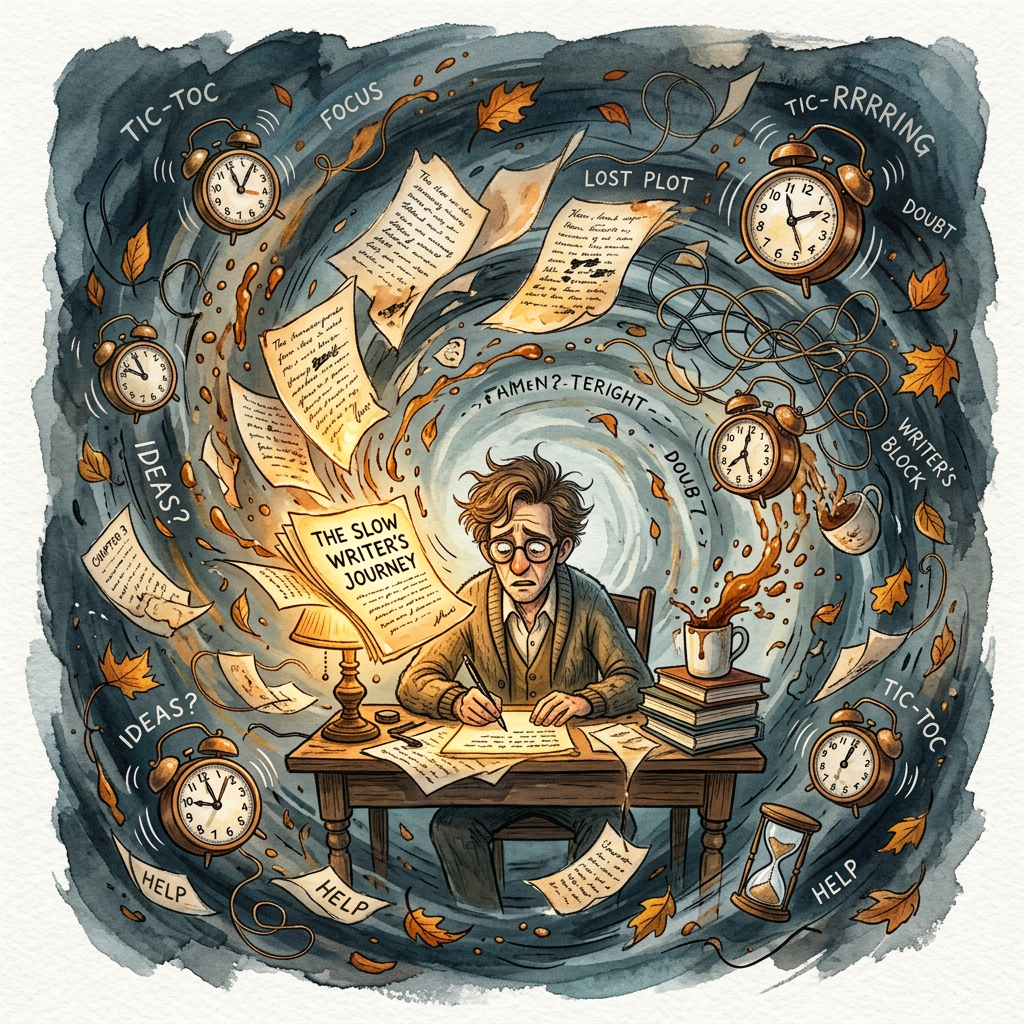
Illustration titled THE SLOW WRITER'S JOURNEY, showing a writer surrounded by clocks, papers, and words including FOCUS, LOST PLOT, DOUBT, IDEAS?, HELP, and WRITER'S BLOCK.
A frustrated writer struggles to create as clocks, tangled thoughts, and unfinished pages swirl around him.

For the record: I have never read Percy Jackson. Nor was it “just fanfiction,” as another friend so cheerfully labeled it. It was a mythological retelling—an ancient and respected literary tradition, thank you very much. But that sting highlights an uncomfortable reality every creative person eventually confronts: Writers and their friends exist in an ecosystem as fragile as a draft saved only on a glitching USB stick.

In my years of typing, stalling, and voice-recording rants in parking lots, I have deduced that every writer has four distinct categories of friends:

  1. The Ghosts: They will never read your work, and they will never support it. If you sent them your manuscript, they’d probably use it as a coaster.
  2. The Cheerleaders Without Glasses: They will never read your work, but they will show up to your readings, buy you coffee, suggest cool indie bookstores, and shout your praises from the digital rooftops. Bless them; we need them.
  3. The Unqualified Critics: They don’t actually understand your genre, style, or creative soul, yet they wield their critiques like a toddler swinging a sledgehammer.
  4. The Unicorns: Cherish them. Guard them with your life. They read your work, remember your characters’ names, and aggressively text you at midnight asking: “When do I get chapter four?”

I recently stumbled upon a viral Instagram post outlining the unspoken rules of loving someone who writes. It resonated so deeply that I felt called out from my car seat. So, as a public service announcement to the well-meaning civilians who share their lives with storytellers, allow me to translate what’s really going on behind the blinking cursor.

1. Hitting “Send” Is an Act of Raw Vulnerability

If a writer hands you a manuscript or emails you a Google Doc, understand that hitting Send took more courage than a lion tamer stepping into the cage. We are essentially handing you our bruised, exposed nervous system printed in 12-point Times New Roman.

I was once on vacation after getting edits back from a writing group. I handed a chapter to a friend whose opinion I truly treasured. They made a parade of polite excuses about how they had “too much on their reading list” to look at it—and then spent the next three days complaining aloud about the terrible published novel they were reading on the beach.

You are not obligated to read my work. Truly. But if you have time to complain about a celebrity memoir you hate, watching you deliberately avoid twenty pages of my soul feels like a slow paper cut. Don’t hit us with, “Oh, the title looks cute!” It’s okay to say, “I don’t have the bandwidth right now, but I’m rooting for you.” Radical honesty beats a transparent brush-off every time.

2. A “Good Writing Day” Can Salvage Our Entire Existence

Writing in the modern world is an uphill sprint through molasses. We don’t live in the 1980s where you could just shut off the cathode-ray television, sit at an oak desk in absolute silence, and hammer out prose without distraction. We live in an era where modern life demands two jobs, libraries close at 5:00 PM, Barnes & Noble tore out all their good tables, coffee shops kick you out by 2:00 PM, and your phone constantly lures you into a thirty-minute TikTok doom-scroll.

Add in real life, depression, and the sheer exhaustion of having ideas in your head but zero energy in your limbs, and stringing 500 coherent words together feels like summiting Everest. If your writer friend announces they had a good writing day, treat it like they just won an Olympic bronze. My boyfriend will light up and say, “I’m so glad you got some writing today!” That single reaction will carry me through the rest of the week.

3. Staring Blankly Out the Window Counts as Hard Labor

When you catch us zoning out into the middle distance, slack-jawed and glassy-eyed, we are not taking a mental nap. We are actively directing a three-act tragedy behind our retinas.

We are deciding whether Janelle would actually slap her boss or insult his loafers. We are blocking scenes. We are figuring out how to describe body language without using the phrase “she let out a breath she didn’t know she was holding.” Once, while sitting in this very car, I watched a bizarre argument between strangers unfold across the street—it had an inciting incident, rising action, and a climax so dramatic it felt like Shakespeare had a fever dream in a suburb. I was taking mental notes the entire time. That wasn’t loitering; that was occupational development. (And yes, wandering a bookstore for two hours is also taxable research.)

4. When We Say the Book Is Trash, Wait Forty-Eight Hours

Every writer has a day where they re-read their morning draft, decide they are an illiterate fraud, and solemnly swear to burn their laptop and take up goat farming. The Secret Son of Hephaestus is currently in literary purgatory because one day I decided the first three chapters were utter garbage.

Give us two or three days. A nap, a sandwich, and a little distance usually reveal that the manuscript isn’t irredeemable trash after all; it just needs a tightened paragraph, a deleted subplot, and slightly better lighting.

5. Specificity Is the Highest Form of Love

If you want to make a writer cry happy tears, do two things: remember our characters’ names, and tell us specifically what made you react.

A coworker once read a romance short story I wrote and casually remarked, “Sophia really deserves her own story after what happened with Camille.” I practically levitated. She remembered Sophia! She treated my imaginary friend like an actual human being!

Saying “It was good” is the conversational equivalent of a pat on the head. But telling us, “I screamed when he slammed the door,” or “This paragraph felt a little rushed, but that one line made me laugh out loud”—that is golden. It proves you were actually inside the world we spent months building in our heads.

At the end of the day, slow writers are still serious writers. Unread writers are still writers. We aren’t expecting our inner circles to act as an uncompensated, unpaid PR agency or a literary agency board.

All we ask is mindfulness. Be honest if you don’t have the time. Be kind if it’s not your cup of tea. But if you’re going to be in the passenger seat of our creative lives, maybe don’t tell us we’re writing fanfiction when we’re trying to build an empire.

Now, if you’ll excuse me, I’ve been sitting in this driveway for fifteen minutes; the car is getting cold, and I have thirty days of blog posts to conquer. Bam. Good night.

Here is the link for the post that sparked this essay: https://www.instagram.com/p/DcoHebUESAD/?stkn=NGN3OGJpdmt3Z3d2

Also, if you would like to read my short stories or chapters, comment belowà I want to read your works ☺️

If you want to support my coffee shop visits: https://ko-fi.com/chemichelletales

Blog at WordPress.com.

Up ↑