The internet loves to treat life hacks like complex puzzles involving three apps, an intricate spreadsheet, and 12 mason jars labeled in calligraphy.
Truthfully, most real-world hacks don’t start as intentional life strategies. They start because you’re tired, groceries are expensive, and you need a way to feed yourself without spending your entire Sunday chopping celery.
If you are trying to cut your food spending and reclaim your weeknights, here are a few practical, low-effort routines worth adopting.
1. Skip Individual Groceries: Buy the In-Store Meal Kit
Buying individual heads of garlic, bundles of herbs, and full containers of spices just to cook two portions often leads to bloated receipts and produce turning to liquid in the crisper drawer.
Instead of building a meal from raw parts, head to the butcher counter or prepared-food section of specialty grocers. The Fresh Market, Sprouts, and Whole Foods frequently sell complete dinner kits for around $25 to $30.
The Fresh Market ($25 Deals): Best when you want control over your flavors. The proteins are often unseasoned, letting you use your own spices rather than committing to a heavy marinade.
Sprouts: Offers the widest protein variety, cycling through shrimp, steak, salmon, and chicken meal deals.
Whole Foods: Great for classic, reliable basics like salmon or chicken paired with pre-prepped sides.
The Strategy: Pick up one kit, roast or sauté the ingredients in 20 minutes, and divide everything directly into glass containers. You get four to five days of prepped lunches or dinners for less than the cost of a single takeout delivery order.
2. Order Fast-Casual Catering Trays Over Individual Entrees
If you rely on dining out during busy weeks, stop ordering single burritos, bowls, or salads every day.
Places like Chipotle and Qdoba offer small catering setups or family-style build-your-own spreads. Buying the bulk components—pans of black beans, grilled chicken, fajita veggies, and rice—yields a significantly lower cost per ounce than paying individual retail markups and delivery fees daily. Portion the components out yourself at home for quick, ready-to-heat lunches.
(A quick note on sandwich shops like Subway or Potbelly: bulk catering platters sound tempting, but fresh bread goes stale quickly. Stick to hot, grain-and-protein bases for meal prep.)
3. Supplement Staples with Food-Rescue Apps
Do not pay full price for items that can easily be frozen or eaten that day. Using an app like Too Good To Go allows you to grab surprise bags of surplus goods from local bakeries and specialty markets at a fraction of their retail cost.
Use this strategically for shelf-stable carbohydrates: picking up a bakery surplus bag can supply your sandwich bread, baguettes, or rolls for the entire week for just a few dollars.
4. Run the Zero-Waste Bone Broth Simmer
When cooking bone-in poultry or stripping down a whole chicken, never toss the carcass. Place the leftover bones into a pot, cover them with water, throw in scraps of onion and carrot, and let it simmer low and slow.
As the connective tissue and marrow break down, you end up with nutrient-dense, collagen-rich bone broth for $0. Strain it, keep it in the fridge, and use it as a flavorful base for rice, grains, or quick soups throughout the week.
5. Add Baking Soda Directly to Musty Laundry
High-intensity gym clothes and older fabrics love to trap residual sweat and body oils that standard detergents can’t break down. Rather than spending money on expensive specialty sport detergents, toss half a cup of baking soda directly into the drum with your wash cycle. It neutralizes persistent odors at the fiber level without ruining the fabric.
What everyday shortcuts or grocery habits do you rely on to keep your weekly routine simple?
Cue the Alicia Keys song “’Cause what goes around comes around/ What goes up must come down/ Now who’s crying, desiring to come back to me? What goes around comes around/What goes up must come down” – Alicia Keys “Karma.”
Today’s WordPress prompt asked a deceptively simple question: Do you believe in karma?
A normal blogger with an ounce of self-preservation would have hit publish on a breezy, three-paragraph meditation about golden rules, returned shopping carts, and positive vibes. A one-word answer “Yes” would have sufficed.
Instead, I sat down, untangled Eastern philosophy, analyzed the cosmic dangers of aggressively non-confrontational pop stars, pulled birth charts on the 2010 rap pantheon, and stared into the metaphysical void.
Let’s unpack the cosmic spreadsheet before I scrap this entire draft for my own safety.
Karma Isn’t a Cosmic Vending Machine
In Western culture, we treat karma like a spiritual drive-thru: you drop in a kind deed, the universe hands you a warm bag of blessings, and if someone cuts you off in traffic, you wait by the curb hoping a deity flattens their tire on the spot. Like no, this is not how any of this works.
Eastern traditions like Hinduism and Buddhism view it less like personal vengeance and more like spiritual gravity an autonomous, inevitable law of cause, effect, and intent. Every action leaves a residue.
Crucially, karma is flanked by concepts like kama, the realm of desire, longing, and how we choose to move through worldly impulses. The friction between desire and consequence is where the universe takes receipts.
Most people assume staying safe means staying quiet. But the universe doesn’t give bonus points for aggressively minding your own business when things go sideways. In the cosmic calculus, aggressive neutrality can rack up just as much debt as active malice.
To illustrate, let’s look at two completely chaotic case studies I definitely shouldn’t be publishing on the internet.
Exhibit A: Nicki Minaj and the Millennial Generational Debt
Enter the Sagitterroist-in-chief.
The early days of Nicki Minaj’s career were a masterclass in the clash between Gen X royalty and Millennial ambition. Gen X elders historically demand respect upon entry, bow your head, kiss the ring, acknowledge the pioneer. Millennials, meanwhile, run on reciprocity: I’ll respect you if you respect me, but I am not bending my knee just because you were here first.
Between Lil’ Kim (Cancer) and Nicki (Sagittarius), the stars never stood a chance. Water and fire: you either lock into a lifelong bond, or you maintain a permanent, on-sight grudge match where crossing paths requires protective headgear.
Nicki used that friction as jet fuel, launching into pop-rap dominance. The universe handed her a massive platform, immense influence, and an explicit test: When the next generation arrives, will you break the cycle, or will you do the exact same thing to them that was done to you?
She picked door number two. Instead of playing the benevolent icon, she doubled down on the fortress mentality, alienating peers and baffling fans while the charts quietly moved along without her. The karmic residue didn’t arrive via lightning bolt; it showed up as fatigue, dwindling goodwill, and lukewarm reactions to tracks that used to set the world on fire. The lesson? If you spend your climb fighting gatekeepers, you cannot become the troll under the bridge when you reach the top without the universe sending an invoice with the due date past due.
Exhibit B: Ed Sheeran and the Perils of the “Nice Guy” Swiss Flag
If Nicki’s karma stems from active conflict, Ed Sheeran’s stems from the illusion of the spotless middle ground. Ed has built a global empire on being universally inoffensive. He plays acoustic loops, smiles politely, and wears hoodies to stadium shows where eighty thousand people sway in unison. He is the human equivalent of unseasoned mashed potatoes: harmless, reliable, and entirely neutral.
Except real life doesn’t always allow for a neutral setting. When serious global issues arise, standing in the exact center and humming softly isn’t a position of virtue, it’s a calculated attempt to protect ticket sales. While other artists drew lines in the sand whether via statements or solidarity moves like Macklemore’s. Ed attempted to hold the middle line.
The karmic punchline for terminal fence-sitters? The middle eventually collapses. When you refuse to stand for anything because you don’t want to offend the venue owners or the promoters, you end up offending everyone who expected a shred of backbone. His traveling band bailed, several artist and fans were disappointed in Ed Sheeran, and the “good guy” sheen wears thin under the weight of not taking a side. Silence has a weight, and eventually, gravity pulls it down.
The Self-Preservation Conclusion
Which brings us back to the prompt: Do you believe in karma?
Deeply. I believe intention dictates residue, that the universe keeps impeccable records, and that trying to cheat the bill by either bulldozing your peers or hiding in the acoustic background will cost you down the road. I also believe in knowing when you’re about to attract your own karmic lightning strike from two hyper-online fanbases and several booking agents.
So on second thought, none of this actually happened. Delete the drafts, clear the cache, and cue the Alicia Keys outro: “’Cause what goes around comes around/ What goes up must come down/ Now who’s crying, desiring to come back to me? What goes around comes around/What goes up must come down” – Alicia Keys “Karma”
Yes, karma is real. Be kind to others, don’t be bitter, watch your intentions, and return your shopping carts. Yada Yada Yada
Today’s prompt asked a simple question: How do you make time for self-care?
Before answering how, we need to talk about what self-care actually is because we’ve been sold a lie. Point blank: self-care has been hijacked and turned into a capitalist venture.
When most people hear “self-care,” they picture luxury bath bombs, spa days, mimosas, and sheet masks. If you want to eat your favorite meal or get your nails done, fine. But consumerism has convinced us that caring for ourselves requires spending money to check out of our lives.
That wasn’t the original point.
The Radical Roots of Taking Care
Self-care didn’t start in a department store. In its modern social context, it emerged from the Civil Rights and feminist movements, gaining serious traction through the Black Panther Party in the 1970s.
Back then, self-care wasn’t an indulgence, it was a survival tactic. It was deeply communal and pragmatic:
Organizing free breakfast programs so families had nutritious food when money was tight.
Setting up community childcare so mothers can attend medical checkups.
Organizers like Angela Davis and Ericka Huggins use yoga, meditation, mindful eating, and mental health practices to sustain themselves through relentless pressure and trauma.
Self-care was political, holistic, and focused on basic human dignity: Go to the doctor. Move your body. Feed yourself well. Guard your mind.
When we strip away the commercial packaging, real self-care is about taking your health and sanity seriously. If your heart is racing, you’re paralyzed by anxiety, and leaving the house feels impossible, real self-care isn’t a scented candle—it’s booking an appointment with a therapist or talking to your physician.
How I Make the Time: The Non-Negotiable Monday
If you don’t actively protect your time, someone else will claim it. That’s why I treat self-care as a structured boundary.
For me, Monday is my anchor. It sounds selfish on paper, but it keeps me whole: Monday is the day I do not do anything extra for anyone else.
I work because I have to work, but after that, the evening belongs entirely to me:
Movement: I hit a fitness class. If the class doesn’t happen, I walk on the treadmill. Moving my body is non-negotiable.
Nourishment: I cook a clean, wholesome dinner to refuel properly.
Reflection: I sit down and write a journal. I map out my wins, my losses, and dump my thoughts onto the page to clear the mental clutter.
Setting aside Monday sets the tone. Throughout the rest of the week, things get messy, schedules collide, and I don’t always win the battle. But having that dedicated baseline keeps me grounded.
Practical Ways to Reclaim Your Space
You don’t need an entire free day to start resetting your boundaries. Here is how to make room in the real world:
Start with 15 minutes: Before the demands of the house take over, take 15 minutes in the morning. Pray, meditate, write in a gratitude journal, or sit in total silence.
Block out phantom appointments: I used to put fake, urgent meetings on my calendar just to secure “me time.” I’d schedule a meeting on “Bank Street” and label it “Meeting with Banker” so no one could book it. Then I’d sit at the cafe on Bank Street, drink my tea, and breathe. Defending your calendar like your sanity depends on it because it does.
Release the guilt around asking for help: Hire a babysitter, trade childcare with a friend, or tell your family you’re off duty for two hours. Stepping away prevents you from running on fumes and lashing out at the people you love.
Encourage your circle to do the same: I tell my partner all the time: go on the bike ride, play basketball, hang out with friends, go find your center. Loving someone doesn’t mean consuming every hour of their free time or demanding they surrender all of theirs to you.
Getting Back to Wholeness
Erykah Badu sang in the song “On and On”. Ms. Badu sing “I was born underwater with three dollars and six dimes/ Yeah, you might laugh ’cause you did not do your math.” You were already born whole. Self-care isn’t about buying new pieces to complete yourself; it’s about stripping away the noise so you can return to that completeness.
Stop letting marketing campaigns tell you what you need to heal. Build a routine that protects your peace, set boundaries that sting a little if they have to, and treat your well-being like the essential work it is.
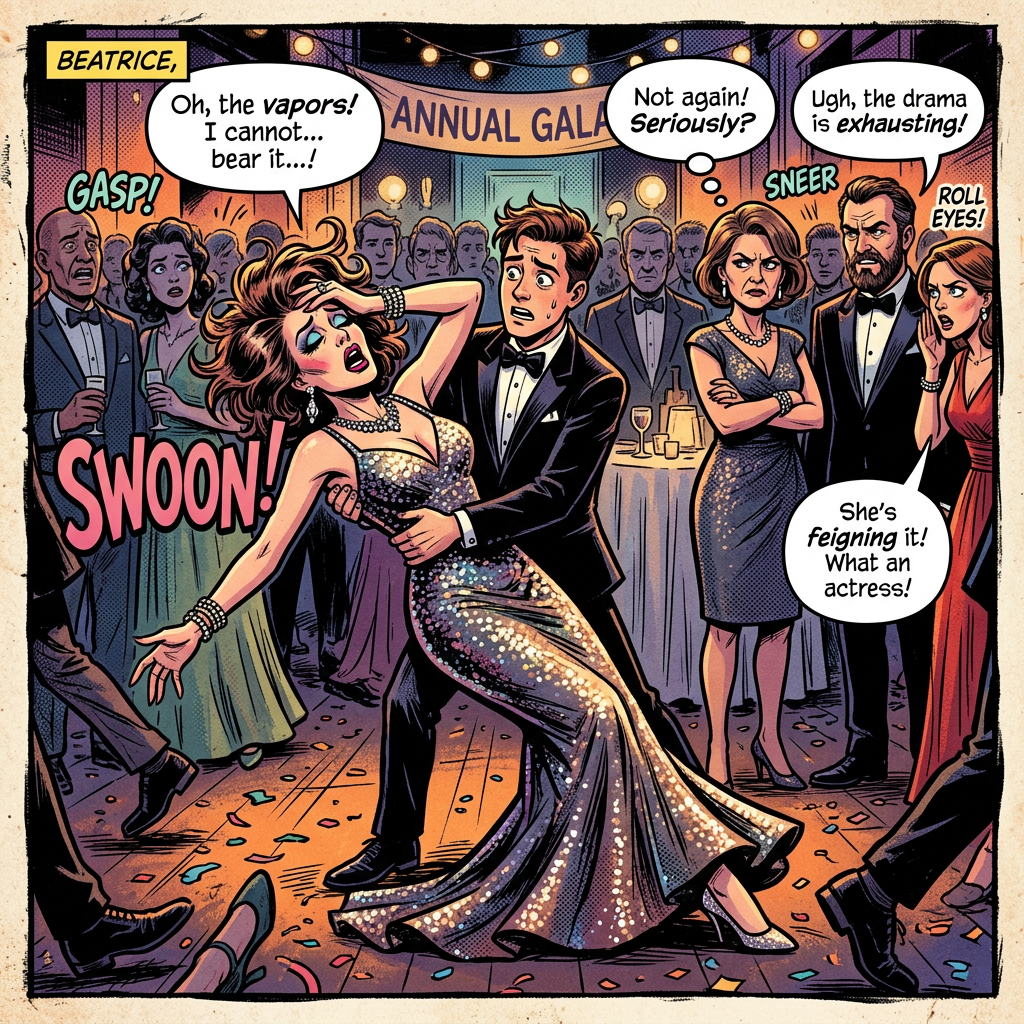
At the annual gala, Beatrice dramatically swoons as guests react with disbelief and concern.
I am still ruminating over a stranger catching an attitude with me, at Sprouts of all places. But this moment has now created two essays to finish the 30 Blog posts in 30 days, and they’re pretty strong, according to the people in my life, and a stranger with a stank face and probably an itchy butthole. I have been living in a state of high theatricality since approximately the 80s. I was recently informed once again that I am “overdramatic.” Naturally, I spent the rest of the evening silently ruminating on this diagnosis, holding a full-blown internal tribunal while processing a quiet loss.
It got me thinking about my lifelong track record with this label. It turns out that society’s definition of “overdramatic” usually means “having a physical or emotional reaction to something actively happening to you.”
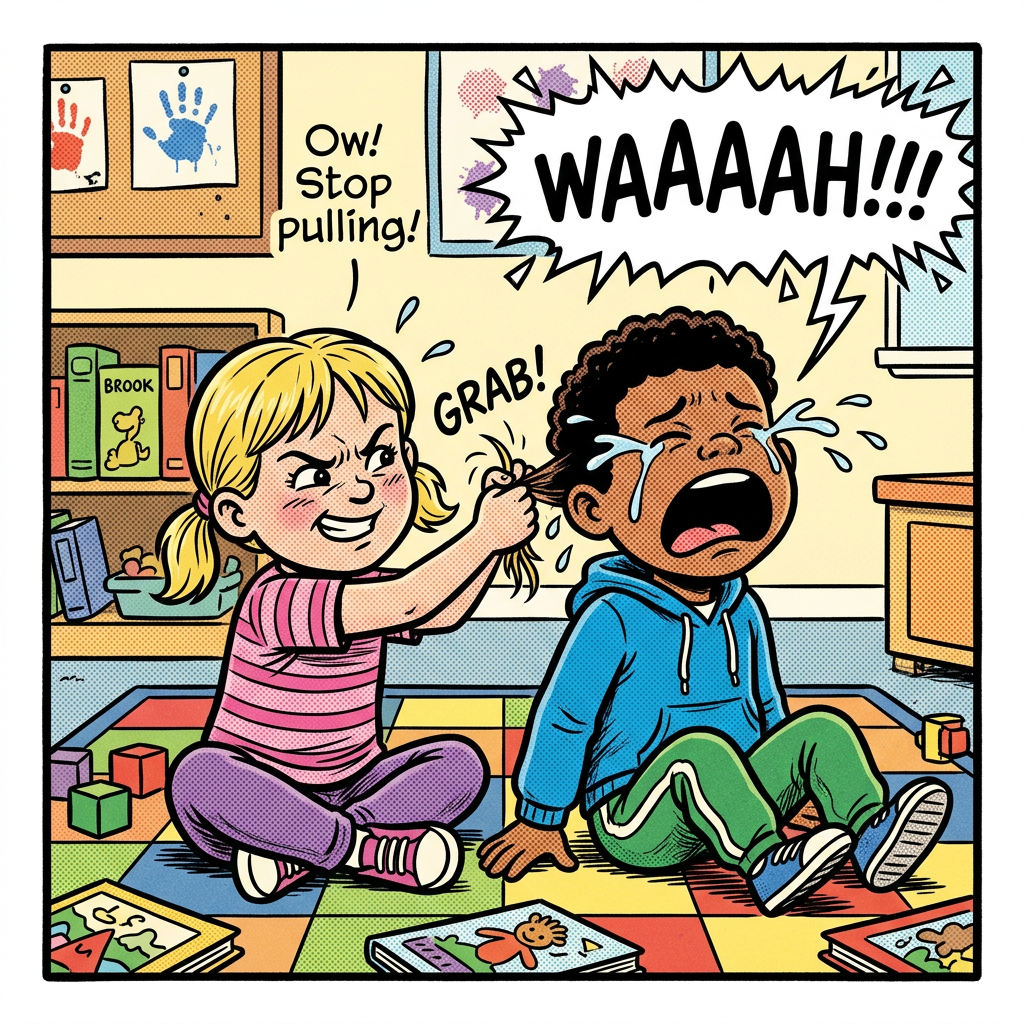
A comic-style classroom scene shows a child pulling another child’s hair as he cries out in pain.
Take my early childhood, for instance. In pre-K, a classmate casually bit me on the cheek. I cried, as one does when being processed as a snack, and was promptly scolded for overreacting. In kindergarten, another child barged into my bathroom stall while I was using the toilet. I screamed to defend my dignity, only to be branded the problem child for breaking the peace.
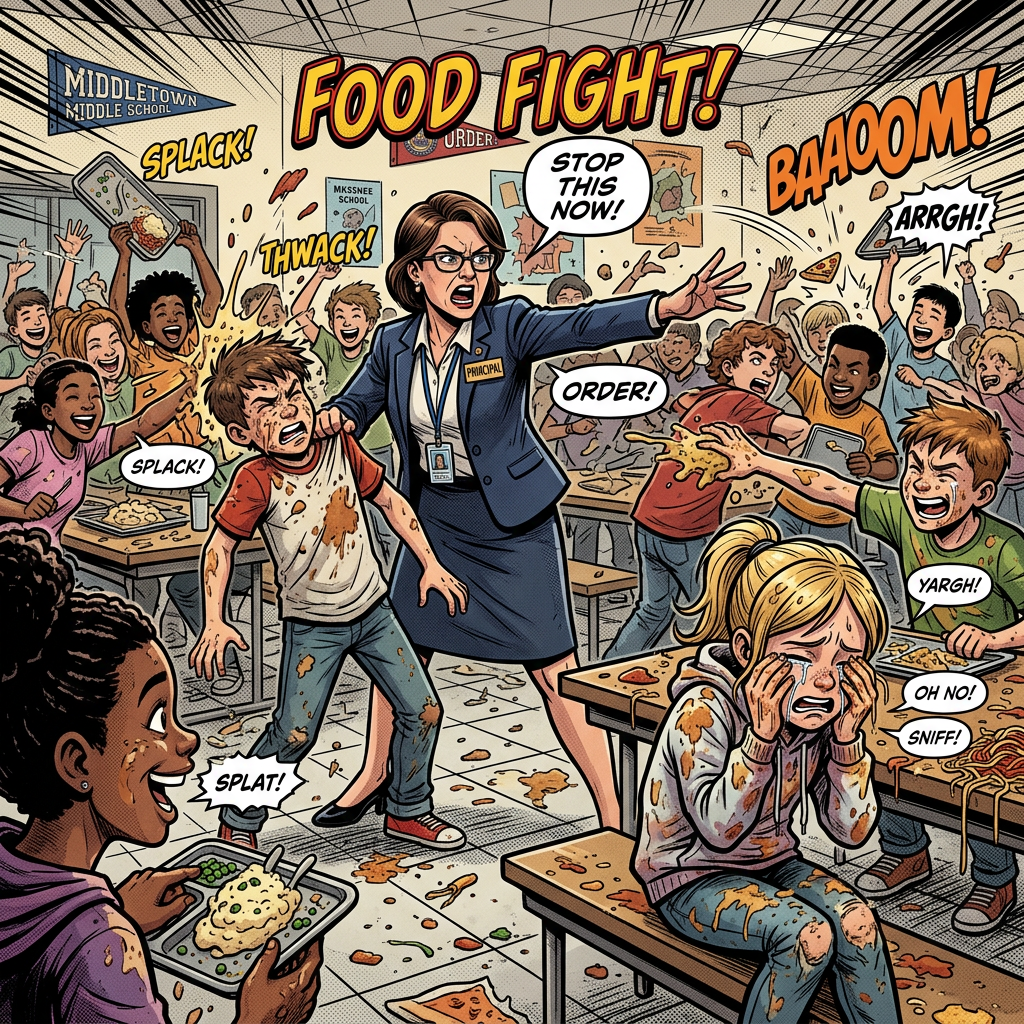
By middle school, the stakes grew higher. During a cafeteria food fight, a boy launched a rogue apple directly into my face with missile-like accuracy, shattering my glasses and swelling my eye shut. Vice Principal Mr. Levy, who, mathematically speaking, is likely retired or floating in the great beyond by now, handed me detention. The offense? Crying too loudly about having an apple hit my eye, and my left eye starting to happen in my socket. When my grandmother pointed out the absolute logical absurdity of punishing the kid with the broken face and crushed specs, the school’s defense was essentially: “Well, she was being dramatic.”
A furious principal struggles to stop an all-out food fight in the school cafeteria.
Looking back, none of these moments were acts of hyperbole. I wasn’t throwing myself onto a fainting couch because the local café ran out of oat milk; I was experiencing basic human cause-and-effect. A bite hurts. A broken pair of glasses hurts. Grief hurts. But when you are labeled “the dramatic one,” your genuine pain gets reclassified as a performance.
Don’t get me wrong, I can admit when I’m being extra. I have the heart of a theater kid, even if I ended up better suited for stage crew than the spotlight. I know what true drama looks like, and I am fully capable of owning up to my own theatrics when I actually pull them. But there is a massive difference between putting on a show and simply refusing to be emotionally paralyzed.
We live in a culture that seems increasingly obsessed with emotional constipation. We are expected to take hit after hit, literal or metaphorical, with the cool, stoic detachment of a statue. If you react, you’re “doing too much.” If you speak up, you’re “emotionally dumping.” We’ve weaponized therapy to tell people to sit down, shut up, and keep their feelings tucked neatly away where no one else has to look at them.
The irony is that denying people the right to feel doesn’t eliminate emotion; it just forces it to curdle. We end up in a society of suppressed human pressure cookers, wondering why everyone is perpetually on the edge of flying into a rage over the smallest things.
True maturity isn’t about feeling nothing; it’s about knowing the time and place. I know how to be neutral and professional at my desk. But at home, watching a sad film or sitting with the grief of losing someone who loved and cared for me for forty years, I claim the right to be human. I demand the right to cry.
Having feelings doesn’t make you a disaster; it just means you’re awake. The next time someone tells you you’re being “overdramatic” for reacting to real life, consider the source. Often, people who demand total stoicism from others aren’t practicing self-control; they are just uncomfortable with the messiness of real human connection. And honestly? They might be the ones who need a little therapy.
AM I THE DRAMA? A One-Woman Tragedy in Four Bottles of Alkaline Water (they were .69 cents a bottle a steal)
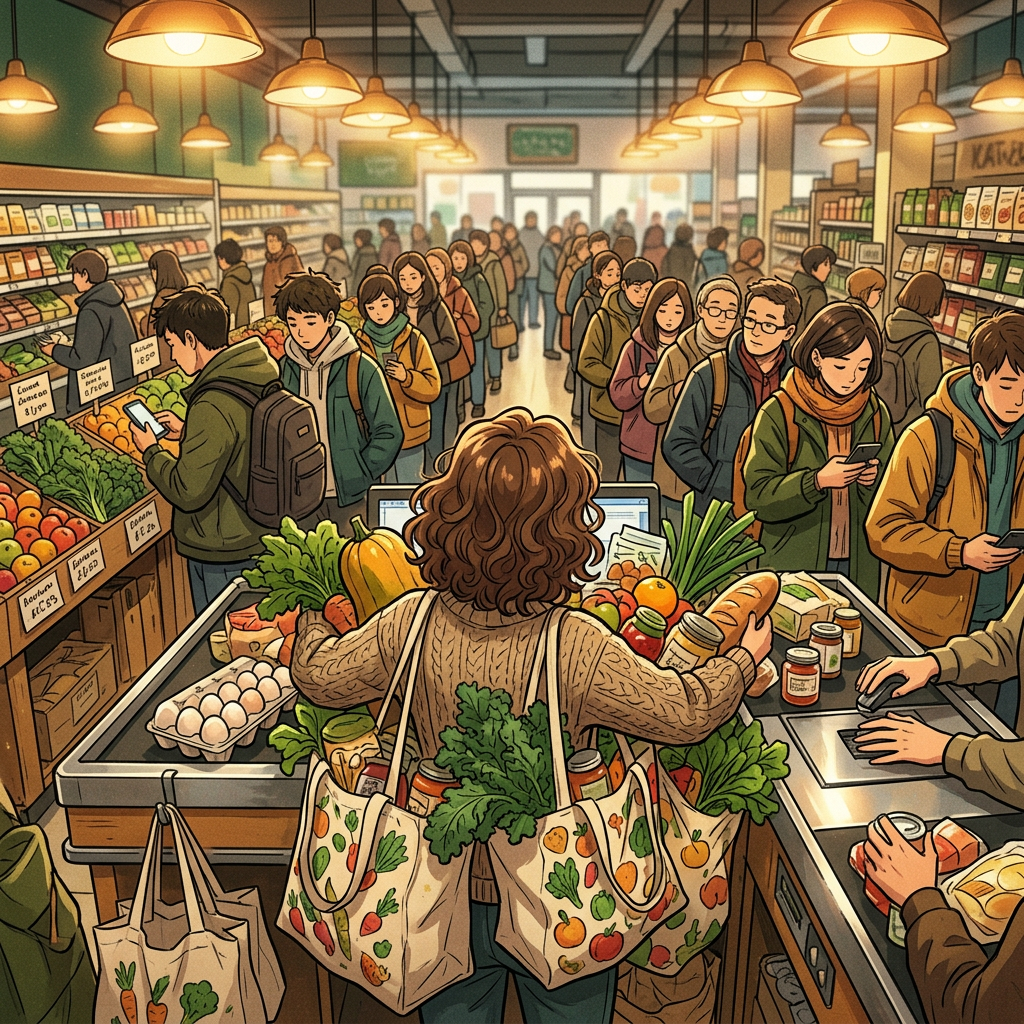
Shoppers fill a warmly lit grocery market while selecting fresh produce and everyday essentials.
“They say, “Cardi, you tweakin’,” nah, I don’t be tweakin’ enough Bitches be doin’ shit, and I been letting it slide, and I don’t be bringin’ it up Bitches be out here tellin’ lies about me, and y’all just be eating it up But when I drag her to hell, “Cardi, you evil as fuck”” – Cardi B “Dead”
Picture it. A Monday. Not just Monday. My Standard routine with my true evening ritual: I go workout and sweat the stress of the day away. Then I go to Staples run to make my copies for trivia, and then and only then the hallowed grocery pilgrimage for lunch for the week. I typically go to Trader’s Joes but tonight I chose Sprouts. I chose poorly.
I walk into Sprouts, a little to happy-go-lucky I am in my Stepford Wives mindset. I end up with the iconic Strawberry Poppy Salad and 4 bottles of alkaline water. I am trying to be healthy. I am working on my self-improvement. No kombucha, because I am TURNING OVER A NEW LEAF, thank you very much. I gather my sad little salad and my four bottles of fancy water like the disciplined baddie I’m trying to become.
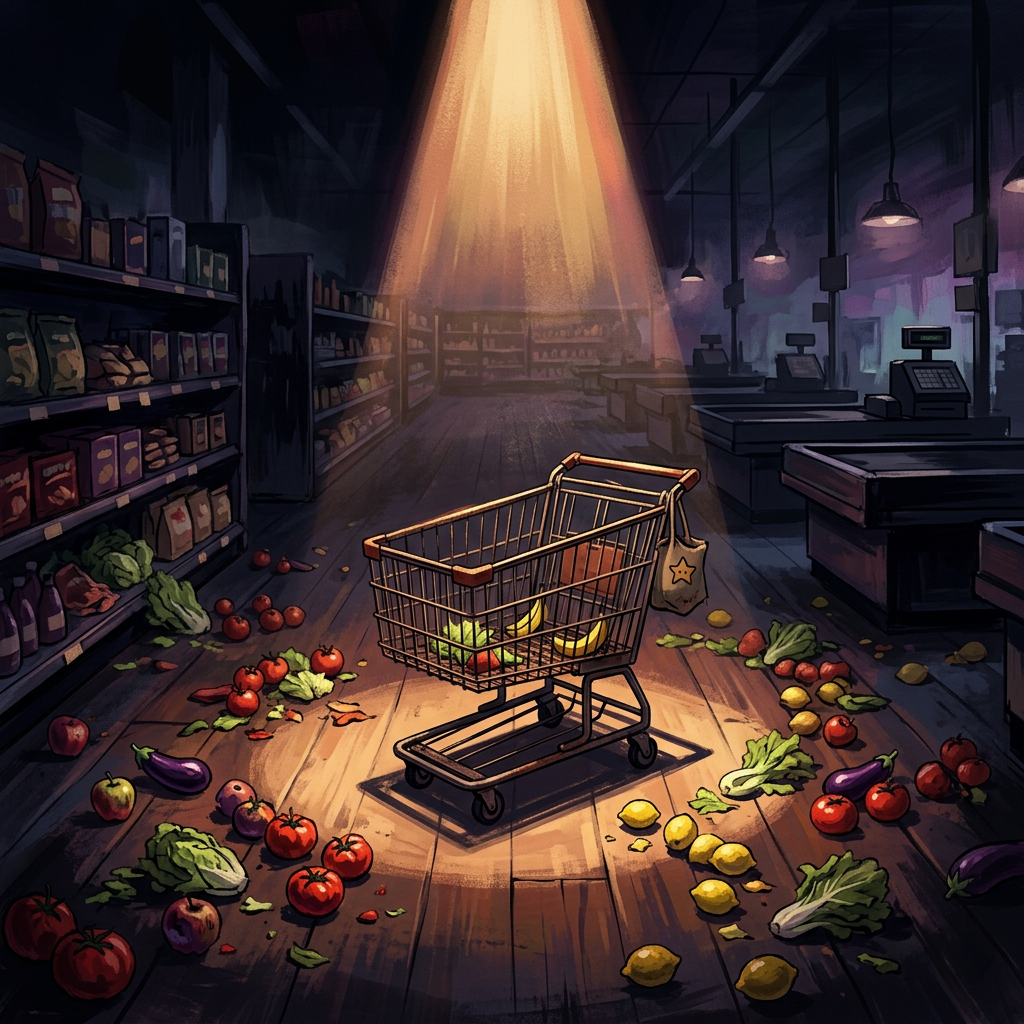
A lone shopping cart stands amid scattered produce in a shadowy grocery store aisle.
And then. THEN!!! I approached the register. I forgot to put the gray bar up to separate the items from the customer in front of me. Forgetting about the sacred conveyor belt divider, that tiny plastic bar that separates each customer, is a crime against humanity. I place my items down like an absolute rookie, and this woman with a bad weave and attitude turns to me with the fury of a thousand suns and snaps, “Can I finish?” rolling her eyes so hard I felt the breeze. I was wondering if she rolled any harder could she see her past life? A part of me wishes I channeled my inner Cardi B, but I channeled my inner Catholic.
I apologize. Dramatically, sure, I’ll own that “OMG, I AM SO SORRY”. But I was SINCERE. And she has the AUDACITY to tell me “Stop being dramatic?? Ma’am. Ma’am. You are the one rolling your eyes, from me forgetting the little gray divider. It’s you, YOU ARE THE DRAMA. The projection of frustration, on a stranger, on me!!! The absolute projection happening at register 1 of a Sprouts on a Monday night.
So, I slink off to another line like a woman exiled from the line of purchasing, and the universe says “We are not done with you yet” the next two cashiers proceed to psychologically ice me out. One’s staring at his name badge like it holds the secrets of the universe. I’m standing there, water bottles and salad, wondering if I should just leave the salad and my dignity behind and drive home in shame.
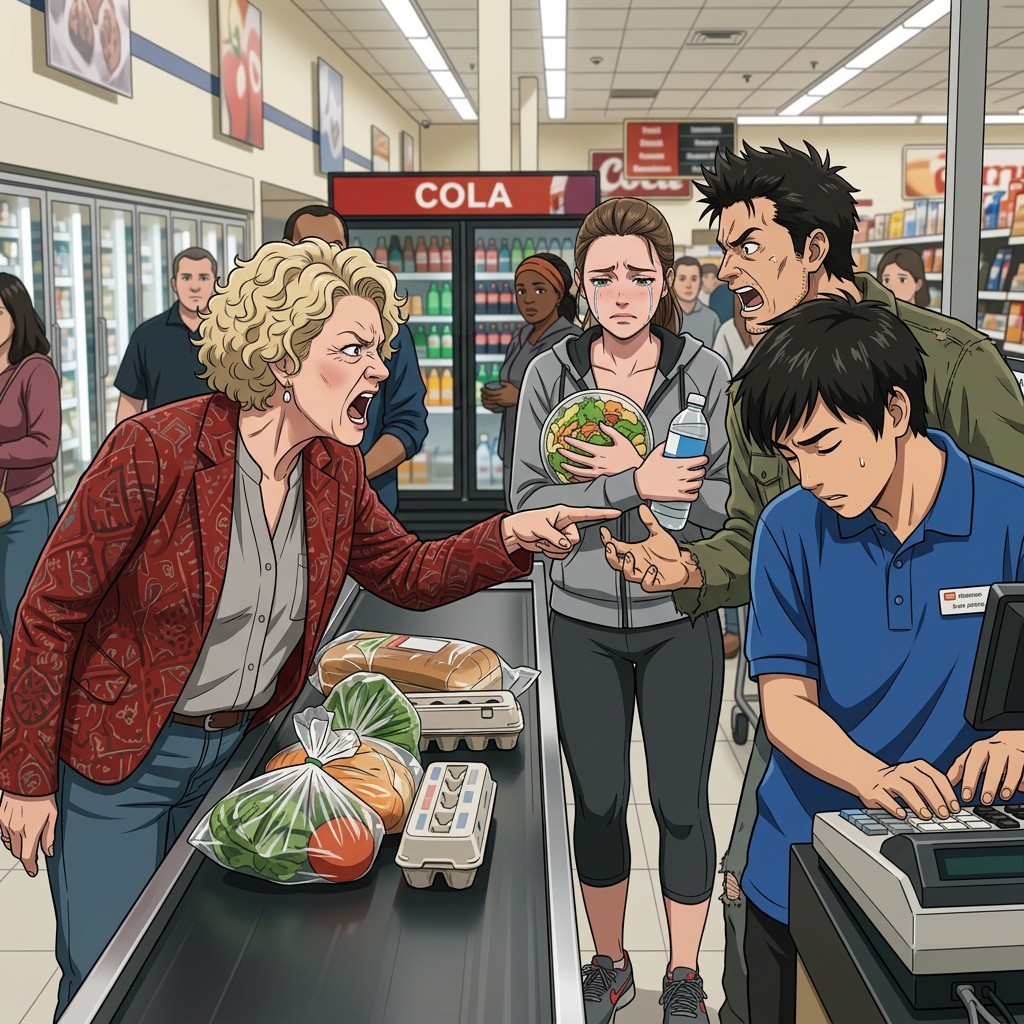
A tense grocery checkout interaction unfolds as a customer questions the cashier while another shopper waits nearby.
It would be great to say I persevered. I got my salad. I got my water. I got home. But I didn’t, I instead put all the items back and left. As someone who desired that delicious salad, while trying to load 2027 Baddie up. One thought echoed through my head was she now thinks I’m dramatic, and honestly? I might be proving her right by mapping out every other Sprouts location in a 30-mile radius. So, I never have to see her again. Is that dramatic? Absolutely. Do I regret it? We’ll revisit going to THAT Sprouts in November of 2028.
But here’s the real ending, I left with no food, because I felt disrespected. Past the bit: that customer was having a bad day that had nothing to do with me, and for one hot second I almost let her bad mood become my bad mood too. I didn’t. I said sorry, I took the L, I left without my Strawberry Poppy Salad. But I kept my Monday intact, with the good vibes I was feeling.
That’s the whole lesson, dramatics aside somebody else’s nasty attitude is theirs. You can hand it right back to them without ever picking it up yourself. I will get a better salad another day, and that delicious Strawberry Salad with feta cheese can feed another person, just not me. I ended up with a bag of Smartfood White Cheddar Popcorn, so much for being a baddie.
What’s the best advice you’d give to someone younger than you?
A WordPress prompt got me thinking recently: what’s one piece of advice you’d give someone younger than you? And honestly, it made me realize something: a lot of people give the wrong kind of advice to younger people. They hand out unsolicited wisdom and then get offended when it’s not welcomed or when they get called a “Boomer”. Well, I agree you’re acting like an out-of-touch Boomer.
So here’s my approach instead. When someone actually asks me for advice, I don’t just start talking. I ask them one question first: “What are you looking for?”
Financial advice, career advice, life advice, relationship advice these are not the same thing, and I refuse to pretend they are. So I ask, and then I give them exactly what they came for. Here’s what that looks like in practice.
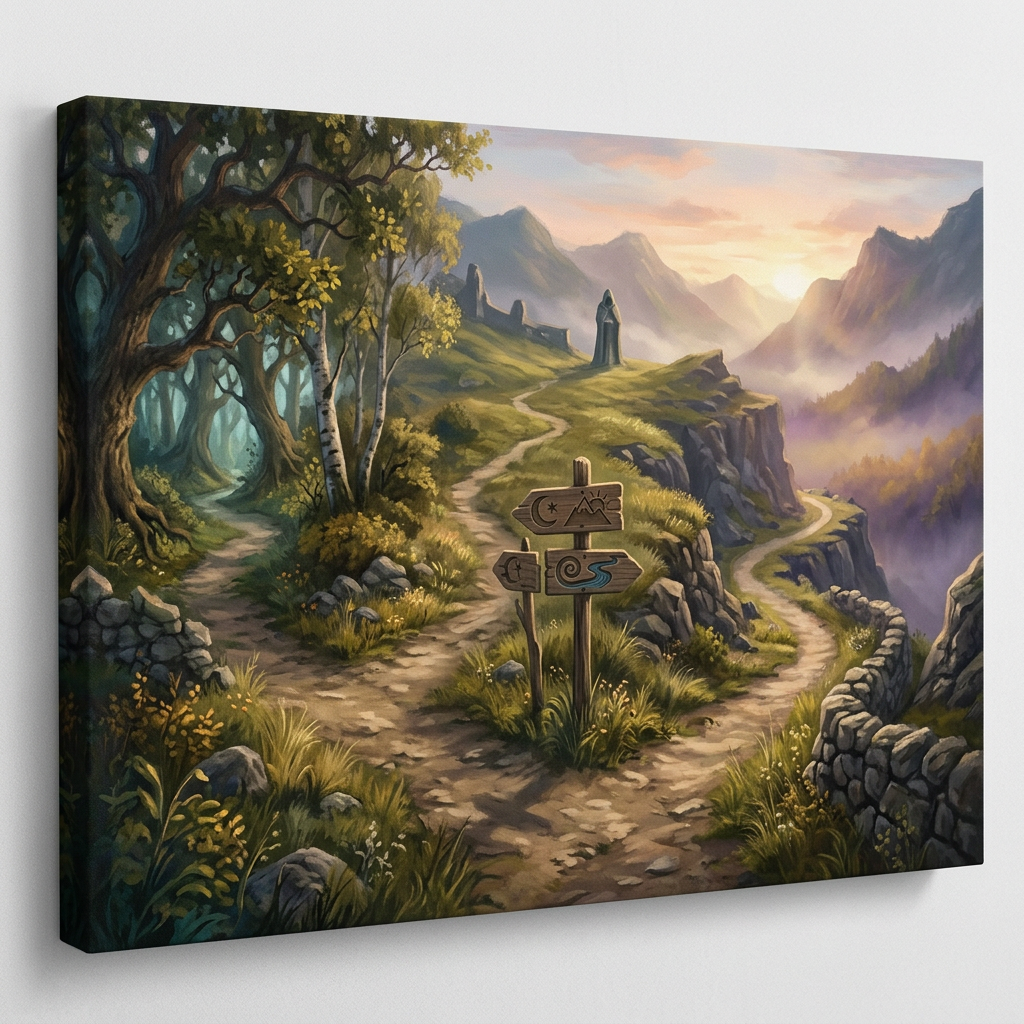
A weathered signpost marks branching paths through an enchanted forest and mountain valley.
On Career
If you ask me for career advice, I’ll tell you the truth as I see it.
Use AI as a tool, not a ghostwriter. Use it to get the right keywords into your resume. Companies are running AI screening on applications now, so you need to speak that language to get your resume in front of a human in the first place. Research the prompts; don’t reinvent the wheel. Once you’ve got a draft, go back through it and humanize it; adjust the language so it actually sounds like you. But keep the keywords. It works!
Use your connections, all of them! Family, community, religious groups, school, your favorite cashier at Target whatever network you have access to, use it. We’ve somehow convinced an entire generation that asking for help makes you “a user.” It doesn’t. Being an actual user or abuser takes a lot more than asking someone for a favor or an introduction. You’re not exploiting people by tapping the relationships in your life to get somewhere; that’s just how it’s always worked. And don’t be shy about asking questions either. Most people aren’t rude, and you’ll find someone willing to point you in the right direction. Also, be willing to help others if someone gives you a lead that leads to a job or opportunity. Say thank you, and be open to helping them if they ever ask, or helping someone else get a leg up.
Hi future self… yes, people will try to take advantage of you when you offer help. You have to develop this skill called discernment.
And one more thing: say thank you. After someone helps you, tell them you appreciate it. It matters.
On Money
There is so much financial advice out there, and everyone’s opinion is different—my honest recommendation: see a professional. If a financial advisor feels out of reach, you almost certainly have access to a bank or credit union. Ask to sit down with a banker and talk it through your budget, your credit card debt, your savings. Don’t let them sell you a loan to pay down your debt unless it’s for you. But yeah, you pay for them by using the bank or credit union, using their resources.
Here’s a tip most people won’t tell you: it’s okay to ask for someone closer to your own age. We assume wisdom automatically comes with age, so we ask someone in their 50s or 60s. Still, someone in their early 30s who recently experienced what you’re in- a new career, first real paycheck, no idea what to do with it often understands your situation better than someone decades removed from it. Yes, it might feel awkward to ask. Advocate for yourself anyway. Don’t take Jim’s advice if he bought his house in 1999 for $80,000 and isn’t paying any student loans. Jim’s first response to you is to stop buying Lattes at Starbucks. “No one is buying Starbucks, Jim!”
Start investing now, with whatever you have. Old advice said to save up $10,000 before you even thought about investing, have no consumer debt, and yada yada yada. That’s outdated. You can start with $5, $10, $20 a week — whatever you can manage without messing up your finances. I started with $20 a week because that’s all I could swing, and I was in severe debt. I also understood that not being in the market was hurting me. So I started building that habit with Stash; it made a real difference over time.
And here’s the part people don’t like to hear: it’s okay to use that money when you actually need it. Long-term investing is great, but if you need that money to survive, to cover rent, a bill, an emergency, take care of yourself first. You can always get back in the market, but make sure you are secure. What good is it to build the habit. The exception is retirement accounts like an IRA, which are built for the long haul. Everything else is there to serve you, not the other way around.
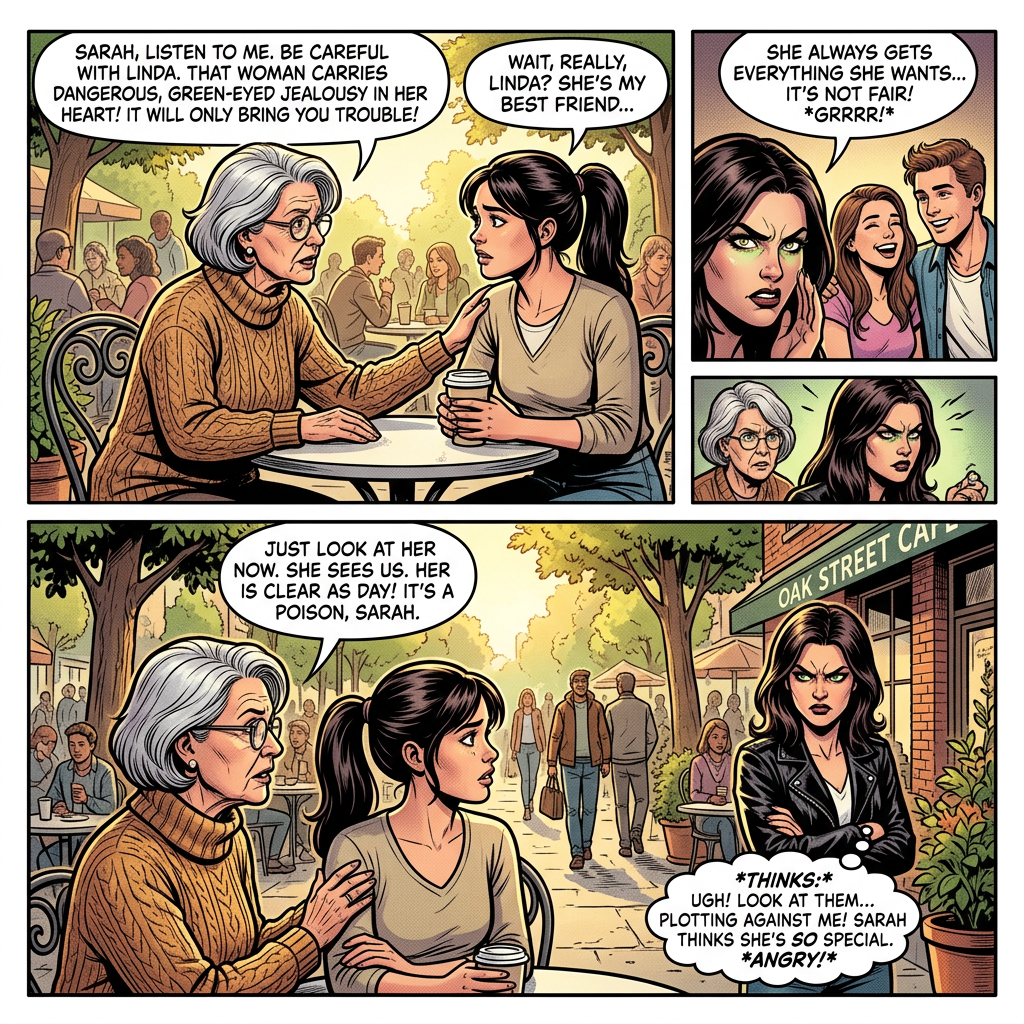
At a café, Sarah is warned about Linda while Linda angrily watches from nearby.
On Relationships
This one’s simple, and it’s the hardest to hear: if someone you trust tells you a person in your life doesn’t have your back, listen.
If someone warns you, “don’t go with that person,” “that person isn’t your friend,” take it seriously, especially if it’s coming from someone who genuinely loves you and has no reason to lie. ( Culturally, especially if it’s a Black woman or Latino woman who says those statements, listen… they have an eerie sixth sense about people.) People who care about you will sometimes see things you can’t see yourself. You don’t have to act on every warning from every person, but pay attention when it comes from someone who’s earned your trust.
Cutting ties is hard. It gets harder as you get older. But you will make new friends; it just takes time.
That’s it. That’s all the advice I’ve got. It’s not polished, and it’s not the kind of thing you’ll find framed on a motivational poster, but it’s what’s actually carried me through, one honest answer at a time, to the question that was actually being asked. Now if you would like more advice, just leave a comment or you can buy me a coffee –> https://ko-fi.com/chemichelletales
Handle With Care: A Survival Guide for Friends of Writers
It is a late Sunday night. I am currently sitting in the driver’s seat of my parked car, in front of my house, utterly paralyzed by exhaustion and avoiding the thirty-foot walk to my front door. It’s that sacred, slightly delirious twilight hour when the engine is off, the streetlights hum, and your brain decides: Yes, this is the exact moment to unpack the existential baggage of being an aspiring author.
A few years ago, I attempted to write a book titled The Secret Son of Hephaestus. The premise was born in a writing class: What if Aphrodite and Hephaestus secretly had a son, but Hephaestus had to hide the child in the shadows so his mother, Hera, wouldn’t obliterate him in a fit of Olympian wrath? It was layered, tragic, and entirely mine. Naturally, the moment I pitched the idea, someone chimed in with, “Oh, so it’s basically Percy Jackson.”
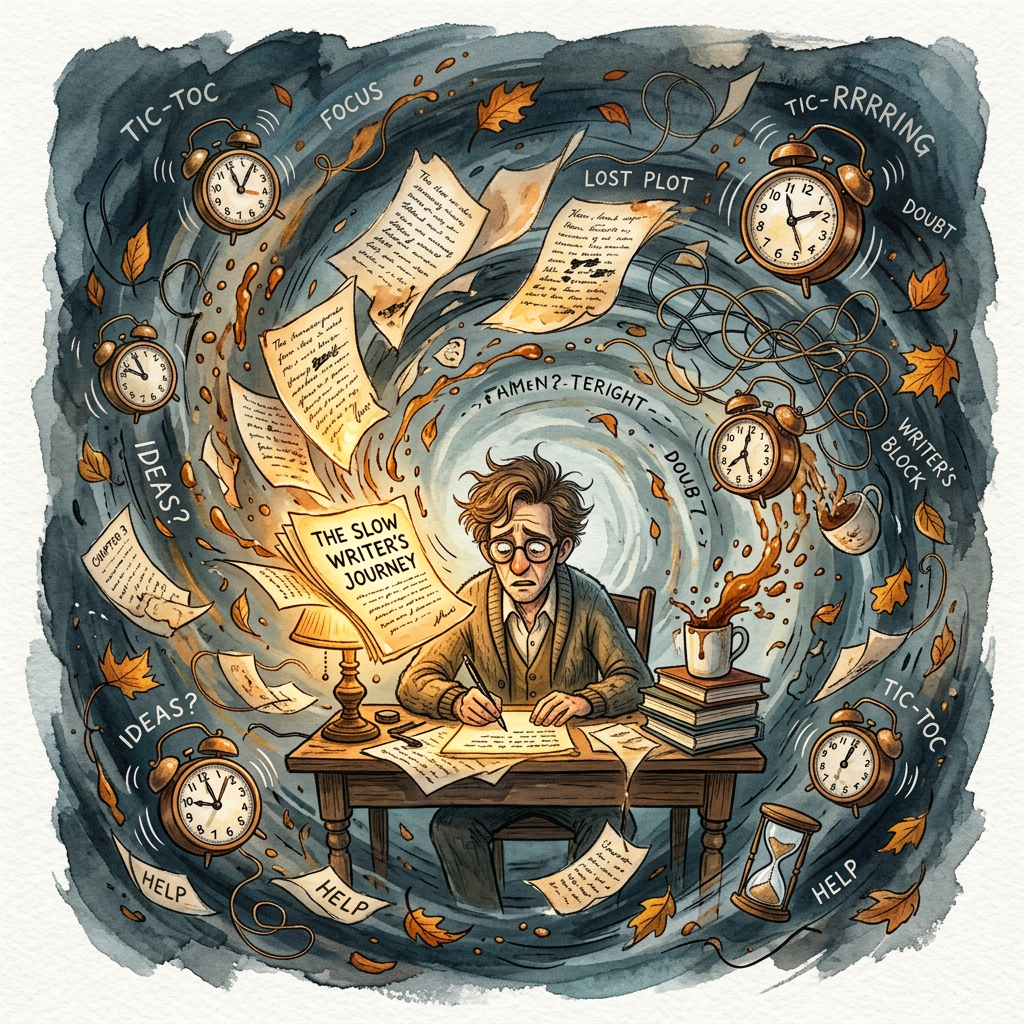
A frustrated writer struggles to create as clocks, tangled thoughts, and unfinished pages swirl around him.
For the record: I have never read Percy Jackson. Nor was it “just fanfiction,” as another friend so cheerfully labeled it. It was a mythological retelling—an ancient and respected literary tradition, thank you very much. But that sting highlights an uncomfortable reality every creative person eventually confronts: Writers and their friends exist in an ecosystem as fragile as a draft saved only on a glitching USB stick.
In my years of typing, stalling, and voice-recording rants in parking lots, I have deduced that every writer has four distinct categories of friends:
The Ghosts: They will never read your work, and they will never support it. If you sent them your manuscript, they’d probably use it as a coaster.
The Cheerleaders Without Glasses: They will never read your work, but they will show up to your readings, buy you coffee, suggest cool indie bookstores, and shout your praises from the digital rooftops. Bless them; we need them.
The Unqualified Critics: They don’t actually understand your genre, style, or creative soul, yet they wield their critiques like a toddler swinging a sledgehammer.
The Unicorns: Cherish them. Guard them with your life. They read your work, remember your characters’ names, and aggressively text you at midnight asking: “When do I get chapter four?”
I recently stumbled upon a viral Instagram post outlining the unspoken rules of loving someone who writes. It resonated so deeply that I felt called out from my car seat. So, as a public service announcement to the well-meaning civilians who share their lives with storytellers, allow me to translate what’s really going on behind the blinking cursor.
1. Hitting “Send” Is an Act of Raw Vulnerability
If a writer hands you a manuscript or emails you a Google Doc, understand that hitting Send took more courage than a lion tamer stepping into the cage. We are essentially handing you our bruised, exposed nervous system printed in 12-point Times New Roman.
I was once on vacation after getting edits back from a writing group. I handed a chapter to a friend whose opinion I truly treasured. They made a parade of polite excuses about how they had “too much on their reading list” to look at it—and then spent the next three days complaining aloud about the terrible published novel they were reading on the beach.
You are not obligated to read my work. Truly. But if you have time to complain about a celebrity memoir you hate, watching you deliberately avoid twenty pages of my soul feels like a slow paper cut. Don’t hit us with, “Oh, the title looks cute!” It’s okay to say, “I don’t have the bandwidth right now, but I’m rooting for you.” Radical honesty beats a transparent brush-off every time.
2. A “Good Writing Day” Can Salvage Our Entire Existence
Writing in the modern world is an uphill sprint through molasses. We don’t live in the 1980s where you could just shut off the cathode-ray television, sit at an oak desk in absolute silence, and hammer out prose without distraction. We live in an era where modern life demands two jobs, libraries close at 5:00 PM, Barnes & Noble tore out all their good tables, coffee shops kick you out by 2:00 PM, and your phone constantly lures you into a thirty-minute TikTok doom-scroll.
Add in real life, depression, and the sheer exhaustion of having ideas in your head but zero energy in your limbs, and stringing 500 coherent words together feels like summiting Everest. If your writer friend announces they had a good writing day, treat it like they just won an Olympic bronze. My boyfriend will light up and say, “I’m so glad you got some writing today!” That single reaction will carry me through the rest of the week.
3. Staring Blankly Out the Window Counts as Hard Labor
When you catch us zoning out into the middle distance, slack-jawed and glassy-eyed, we are not taking a mental nap. We are actively directing a three-act tragedy behind our retinas.
We are deciding whether Janelle would actually slap her boss or insult his loafers. We are blocking scenes. We are figuring out how to describe body language without using the phrase “she let out a breath she didn’t know she was holding.” Once, while sitting in this very car, I watched a bizarre argument between strangers unfold across the street—it had an inciting incident, rising action, and a climax so dramatic it felt like Shakespeare had a fever dream in a suburb. I was taking mental notes the entire time. That wasn’t loitering; that was occupational development. (And yes, wandering a bookstore for two hours is also taxable research.)
4. When We Say the Book Is Trash, Wait Forty-Eight Hours
Every writer has a day where they re-read their morning draft, decide they are an illiterate fraud, and solemnly swear to burn their laptop and take up goat farming. The Secret Son of Hephaestus is currently in literary purgatory because one day I decided the first three chapters were utter garbage.
Give us two or three days. A nap, a sandwich, and a little distance usually reveal that the manuscript isn’t irredeemable trash after all; it just needs a tightened paragraph, a deleted subplot, and slightly better lighting.
5. Specificity Is the Highest Form of Love
If you want to make a writer cry happy tears, do two things: remember our characters’ names, and tell us specifically what made you react.
A coworker once read a romance short story I wrote and casually remarked, “Sophia really deserves her own story after what happened with Camille.” I practically levitated. She remembered Sophia! She treated my imaginary friend like an actual human being!
Saying “It was good” is the conversational equivalent of a pat on the head. But telling us, “I screamed when he slammed the door,” or “This paragraph felt a little rushed, but that one line made me laugh out loud”—that is golden. It proves you were actually inside the world we spent months building in our heads.
At the end of the day, slow writers are still serious writers. Unread writers are still writers. We aren’t expecting our inner circles to act as an uncompensated, unpaid PR agency or a literary agency board.
All we ask is mindfulness. Be honest if you don’t have the time. Be kind if it’s not your cup of tea. But if you’re going to be in the passenger seat of our creative lives, maybe don’t tell us we’re writing fanfiction when we’re trying to build an empire.
Now, if you’ll excuse me, I’ve been sitting in this driveway for fifteen minutes; the car is getting cold, and I have thirty days of blog posts to conquer. Bam. Good night.
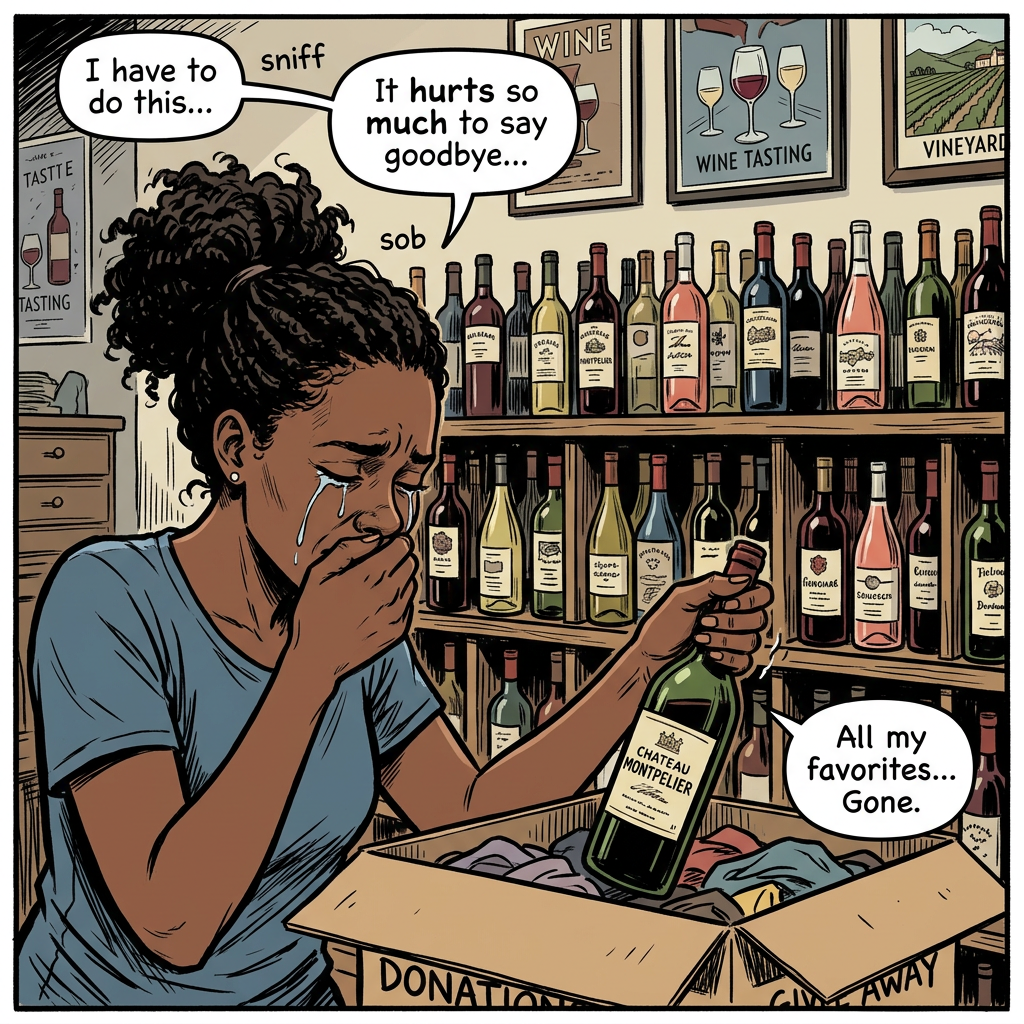
A tearful woman packs her favorite wine bottles for donation, saying goodbye to cherished memories.
Let me say this up front, under oath, hand on the bottle of Sauvignon Blanc I am no longer allowed to finish. Thank you, 40s, for taking the one thing I love. I love, well, I LOVE WINE! I love it the way some people love their pet chihuahua or a decade-old grudge from a frenemy, which they can never remember how it started. But Susan, when I see you in the streets, it’s at sight! I digress; I love wine, in an unhealthy way, but I also know when to stop. At one point in my life, I dreamed of becoming a sommelier. I saved up money and dreamed of opening a local wine shop, with the shop name in cursive on the awning. Special tastings, book events, even cooking classes. I understood wine as a language and a culture before I understood it as a drink. I grew up Catholic, so during communion we would take a sip of wine to represent the blood of Christ. On milestone birthdays, or even special occasions, a bottle of champagne was customary. The glass of wine to toast a life well lived before saying goodbye to a loved one, because some things are too big for words, and a toast feels right before saying goodbye forever. I was raised in this culture; I learned how wine pairs with meals and events, and how it’s used. My family introduced me to the fine culinary rituals of wine, the same way other families introduce kids to Little League early, with the confidence that I’d be good at it.
So understand what follows is not a wine takedown. It is a eulogy to say goodbye to an aspect of my life that I outgrew, or my Liver said no more. And like most eulogies, it has three parts, and only two of them make me look good.
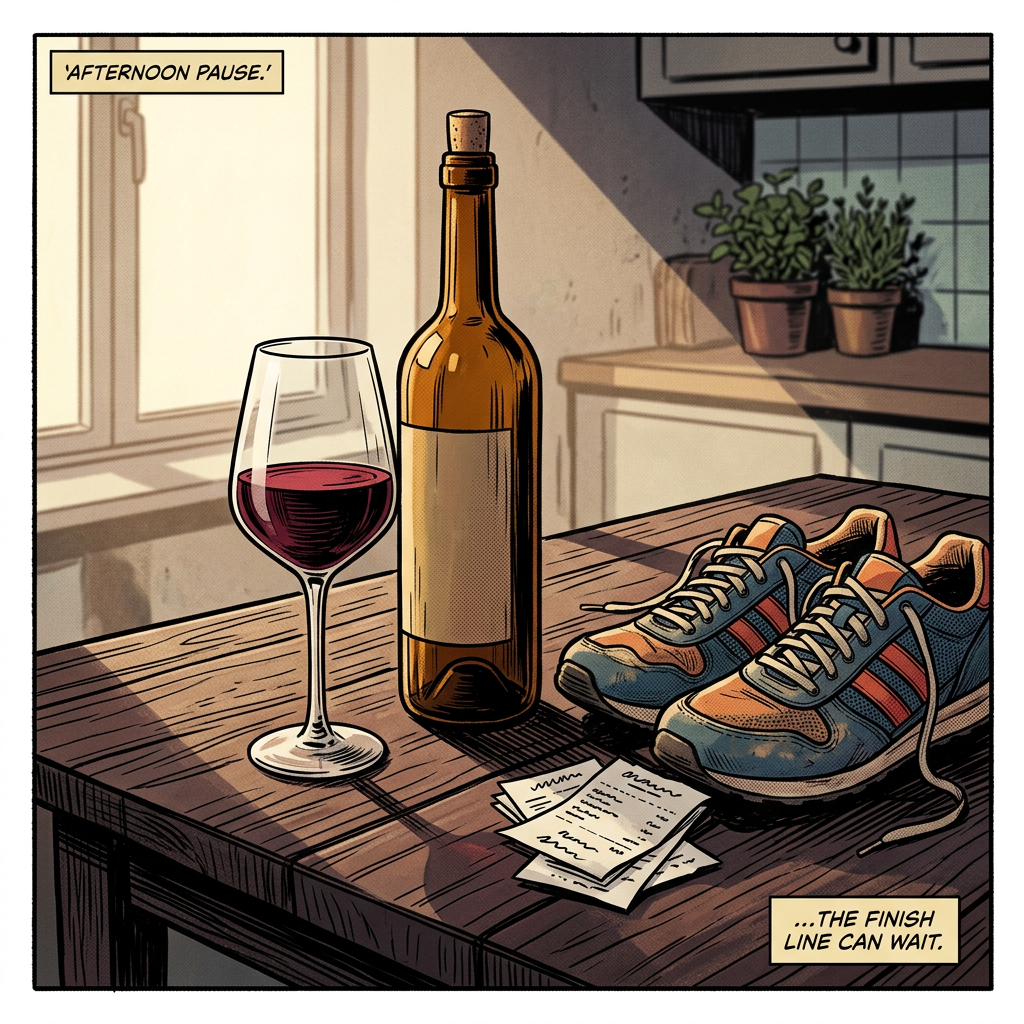
A glass of red wine and running shoes invite a well-earned afternoon pause.
Reason One: My Body Filed a Complaint
Somewhere around 2023, I noticed I was gaining weight despite working out three- to five-mile runs, weight-lifting, and watching what I ate. My body betrayed me and packed on the pounds, disrespectfully. The weight I was gaining was the fitness equivalent of studying all night and still failing the test. Turns out the problem wasn’t just the wine. Hormones were changing and not letting any ounce of fat go, turning everything into visceral fat. It didn’t help that over the two years, a parade of fitness instructors and trainers seemed personally offended by my request to train my back, shoulders, and arms instead of doing squat variation #47. I want a total body workout, not just a booty buster. I am not that girl; give me some deadlifts and chest press. For the love of GOD, let me do a clean and press for 15 reps, for three rounds.
I want a sculpted back. I want defined arms. I would like, once, to finish a workout without someone implying that my only redeeming quality is my corn-fed, hills-walking booty that I have because of genetics. One trainer straight-up asked if I wanted “a fat ass for my man. “Ma’am. I don’t give a fuck about what a man wants! This is my body. I am the one who lives in this body. I get to decide what it looks like, not some future man.” I digress; I’m in my 40s now, and my liver, gallbladder, pancreas, and any other organ have opinions on my wine intake. Opinions I did not ask for! But trying to keep my internal organs healthy and happy. An overrated fine, and necessit..) I made the boring, responsible decision to save wine for special occasions. If I do decide to partake on the rare occasion I must drink, I must have wine before 8 p.m., like I’m a toddler. I plan the next day around “detox.” This is not glamorous. This is a grown woman doing math before a glass of pinot noir. The indigestion, four extra pounds, and elevated liver enzymes are not worth it. And to the person already forming the words “You shouldn’t drink at all! It’s bad for you!” Kindly keep that to yourself.
Reason Two: My Bank Account Filed a Complaint
This reason is the least poetic and the most honest: money. I work two jobs. In a fair universe, that buys me unlimited $15 bottles of wine on sale with a coupon. We do not live in that universe. We live in a universe where someone thought Herbert Hoover’s idea of tariffs was a great idea, as a bottle of Italian wine goes from $7.99 to $18.99 because, say it with me, TARIFFS! Before I turned 40, I spent roughly a few hundred dollars a year on wine, which, written down like that, is not bad. These days it’s closer to a hundred, maybe less, spread out over a year. I have learned to nurse a bottle slowly as it owes me money. I even stopped gifting wine, mostly because everyone I know has quietly done the same math I did, or has become a wine snob. Please read the next paragraph for better context. Cutting the wine budget was, unglamorously, one of the best financial decisions I’ve made. No cinematic redemption arc here. Just a woman choosing her savings account over a Cabernet, and feeling, against all odds, pretty good about it.
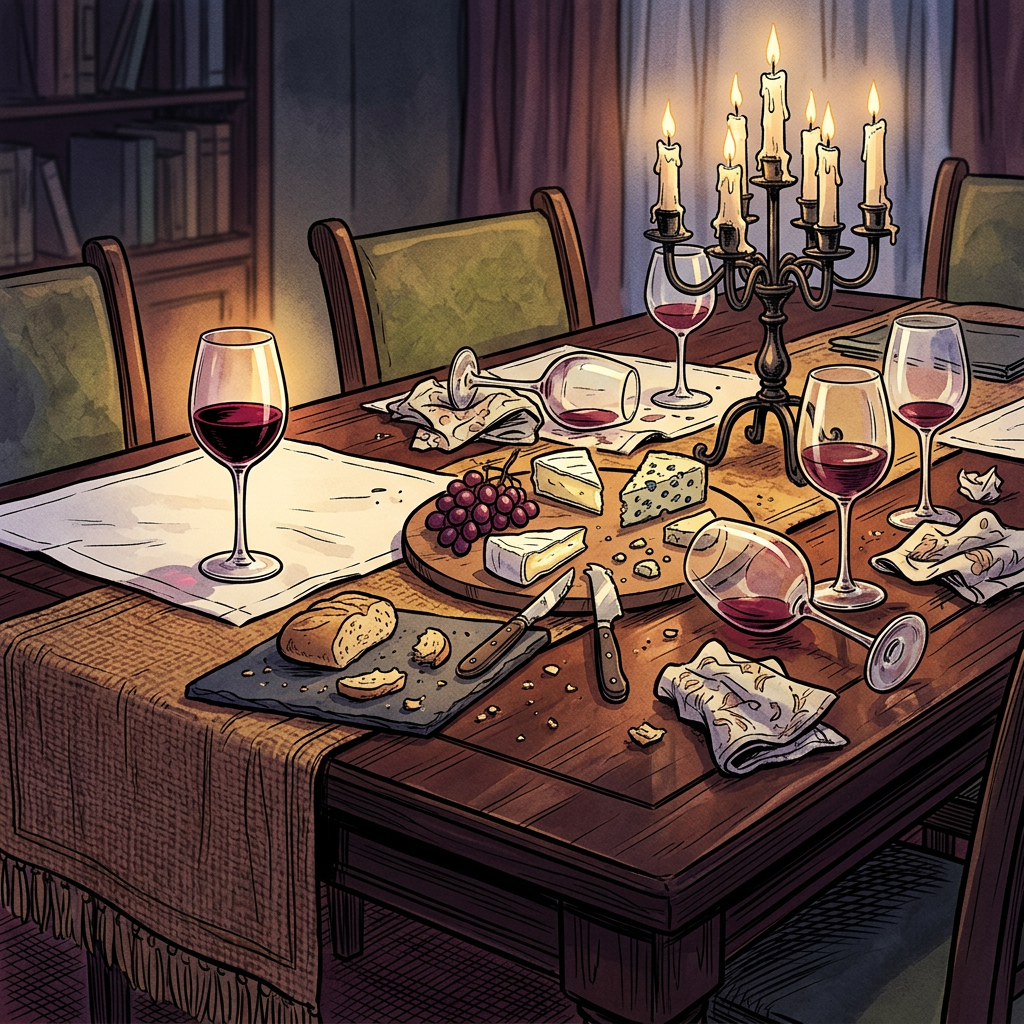
A warmly illustrated dining table invites guests to enjoy wine, cheese, and candlelit conversation.
Reason Three: My Friends Ruined It, and I Will Not Be Taking Questions or Opinions on this hot take
Here is the actual dagger. Not my liver. Not my budget. It was my friends. Et Tu -Bianca, Et Tu! (Pause if you don’t know the Et Tu line; go read Julius Ceaser. Read the classic if you want to learn the 48 laws of power, not the Robert Greene Book; back to our crafted Rant.
Somewhere along the way, a portion of my friend group transformed from “people who enjoy wine” into wine “SNOBS,” a much more insufferable species of wine lover. Not the fun kind of wine lovers who have restaurant connections and a taste for the elusive bottle of wine. They actually know all the history and details, smiling as they regale you with their time in France learning about this wine. (Shout-out to Fred from Total Wine, amazing teacher, sarcastic wine lover; I would have a glass with you anytime.)
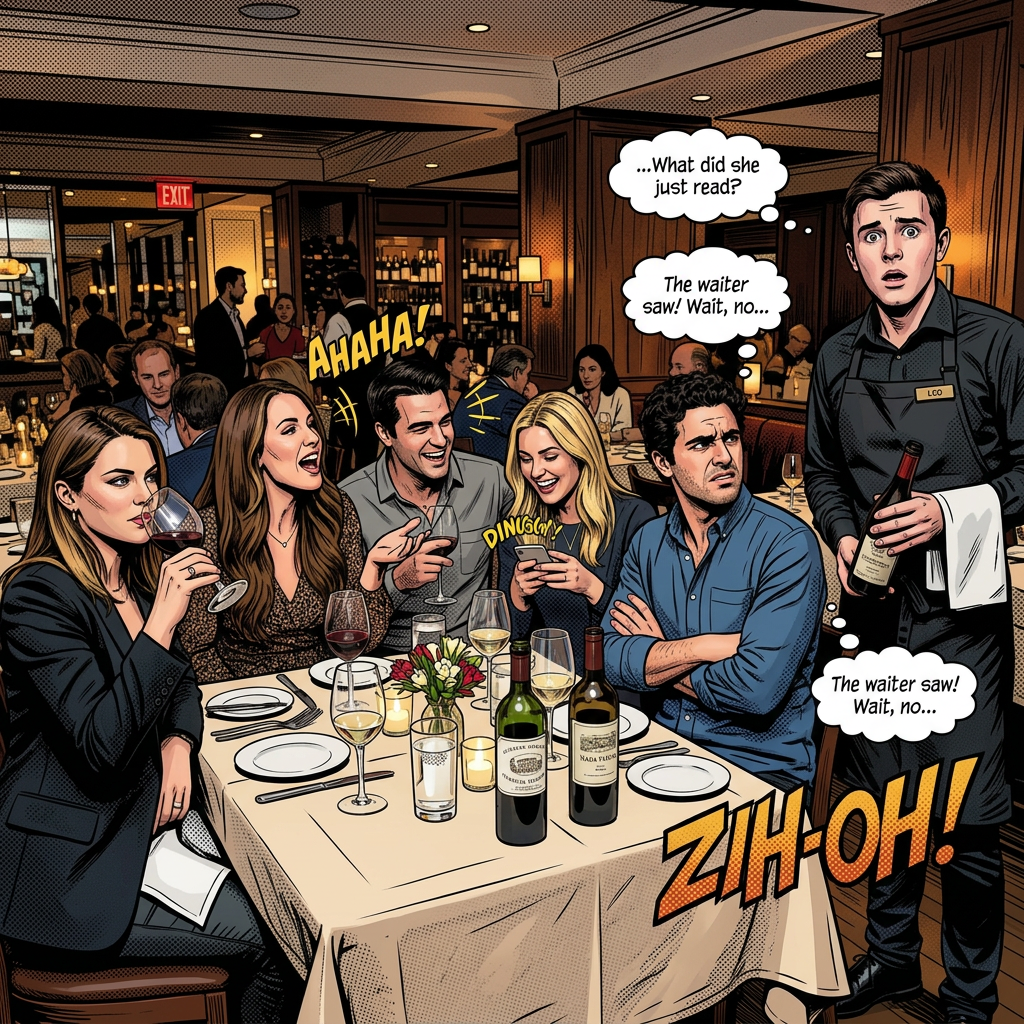
Friends share wine, laughter, and conversation during a lively restaurant dinner.
I mean the kind who cannot let an opinion pass unchallenged, even when the opinion is mine, about my own mouth, tasting wine with my taste buds; case in point: the champagne and fried chicken incident. Pause, I know that wine and Fried Chicken can go together. However, not all champagne pairs well with fried chicken. It’s like eating a banana with coffee; your breath will smell like Hot Sh!t. On this day, that particular champagne had the word ” aperitif ” on its label. An aperitif is a pre-meal palate-waker/cleanser, not a companion to fried food. This particular wine didn’t work for me with fried chicken. I was not asking for a debate. I was reporting sensory data from my own tongue. And one of my friends at the table decided this required a rebuttal, inevitably ending with the suggestion that, of course, it would pair with fried chicken. I quietly ate and drank nothing that evening. You are not going to tell me this wine complements the fried chicken when the wine was clashing with salt and oil and, on top of that, the cool charcuterie of cheese and prosciutto.
Another time, someone not worth calling “Friend” decided to force me to have Riesling with my meal. Hear me out, I love Riesling, but it has its time and place. It follows a spectrum from super sweet to super dry. No, these are not sommelier terms, but I had dreams of becoming one, and obviously, if you are reading this, I am not a sommelier. The wine arrived with our meal. I was having roasted fall vegetables with a spice element and a dry Riesling, which messed with my tongue; I tasted more bitterness and a metallic taste. I personally wanted a nice Red to complement the Smoked Paprika and chipotle seasoning. The other person smiled and grinned, saying, “Isn’t it great?” My face as I watched them eat their smoked fish and try to act like it was the perfect pairing. You can drink wine with anything, but sometimes it’s ok to ask the server for a suggestion or trust your taste buds rather than force a fake smile. Ahh, those vegetables deserved a better wine. Before someone says, the Riesling would have been fine, again my taste buds, my mouth, my digestive system.
Then there’s the Snooty friend at dinner, ordering red wine with a small speech attached, the pointed looks exchanged between me and the server, like we’re all confused about the speech for ordering wine. Meanwhile, I’m eating my vegetables, telling the server, “ Please bring me the wine the sommelier or chef suggested with the meal.” Now I would like to state that I know that I am just as pretentious as my snob friends. You know when people are staring at you, judging you, and saying “oh, you ordered that?” or “I am surprised you ordered that?” Looking at the server giving the knowing look, we understood each other and what was exactly happening: they’re upselling the bottle with the highest markup, and I would rather trust a stranger’s inventory than sit through a monologue about tannins from a friend who just learned the word 10 minutes before dinner.
I don’t want wine to be the whole conversation. I want it to be the icebreaker, not the entire evening’s agenda. I don’t need a treatise on why you, personally, deserve the Riesling. I need you to relax, order the Moscato you actually want, and talk to me about literally anything else: politics, Bravo, the weather, our various ongoing personal collapses, the horrible co-worker that you hate. Drinking with these particular people didn’t make me feel included. It made me feel like I’d wandered into a time-share seminar I never signed up for. To be clear, it’s not all friends; there’s a small, beloved exception to this rule: the friends who will always get a glass poured in their honor, no questions, no commentary. The friends who understand the wine is a part of the experience, not the experience. They invite you over to watch TV and have wine and food on deck. The TV is on mute, with ambient lighting to enhance the laughter of friendship. Just a wonderful time with people who love you more than being pretentious. A good time. You know who you are. Everyone else: you turned my favorite ritual into a performance review, and I stopped attending.
The Verdict
So here’s the accounting, in order of how much it hurts to admit: I stopped drinking wine for my health, because the body in your 40s does not forgive the way your body in your 20s did. I stopped for my finances because a savings account and investments are, shockingly, more satisfying in the long term than a $15 bottle with a coupon. And I stopped, honestly, because a handful of people decided that loving wine wasn’t allowed to be simple anymore. Turns out a pretentious wine snob is a special kind of insufferable, worse, even, than someone who won’t admit they’re wrong. Both are annoying, but it turns out they’re related and deserve each other.
P.S. I had a bottle of wine it was called Clean Slate Riesling 2024. It was amazing ! I need to get another bottle ASAP. Would you like to buy me a glass of wi…coffee 😊 →Ko-fi.com/chemichelletales
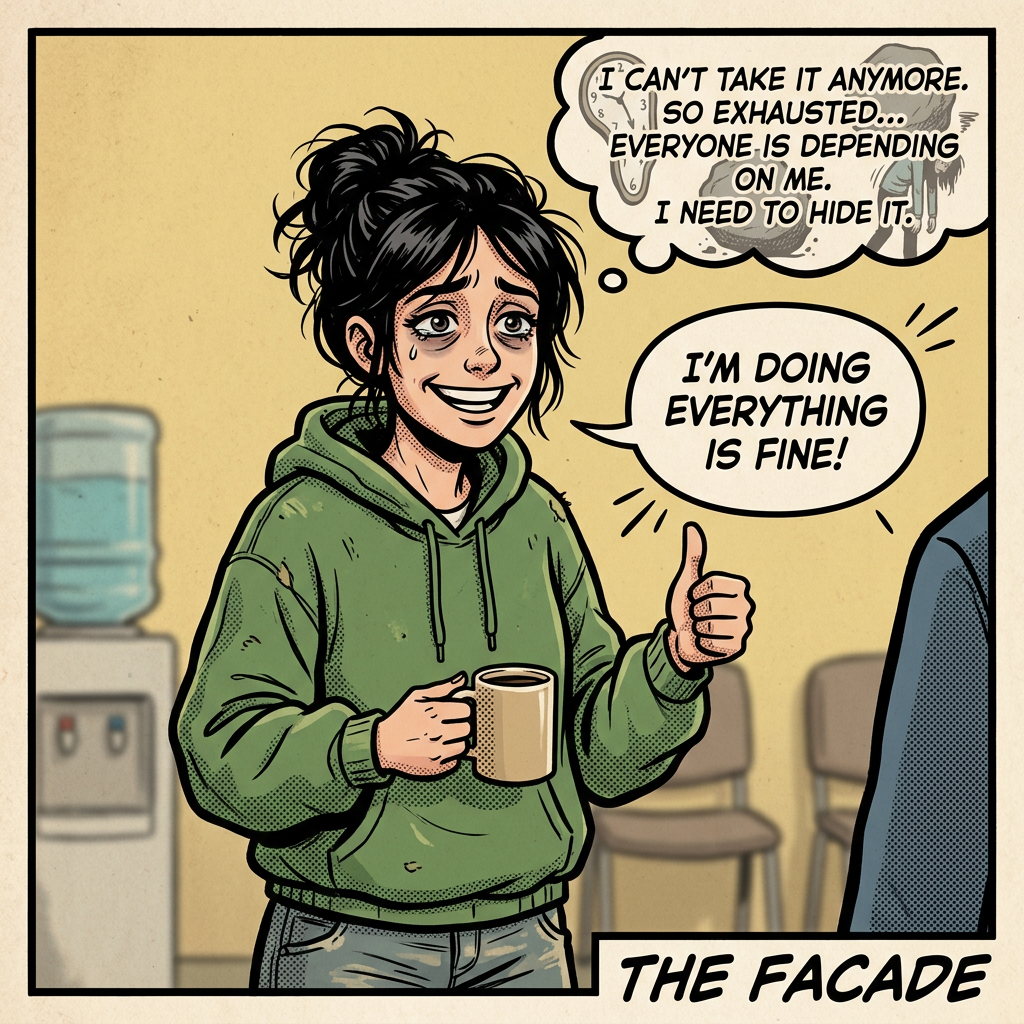
A tired worker hides overwhelming stress behind a reassuring smile and thumbs-up.
“I’m on the pursuit of happiness, and I know/ Everything that shine ain’t always gonna be gold/ Hey, I’ll be fine once I get it/ I’ll be good”- Kid Cudi.
We treat happiness like a destination. Chase it long enough, the thinking goes, and you’ll finally arrive and stay there. But that idea is backward, and it’s setting people up to feel broken for no reason.
Happiness Isn’t a Permanent State
Happiness is tied to a moment, not a lifestyle. It’s the spike you get from a specific event like getting good news, nailing a deal, or a great surprise, not a baseline you maintain forever. Psychologically, it works like a dopamine response: something raises it, then it comes back down. That’s not a flaw in the system. That’s the system.
The cultural script we’re handed says otherwise. We’re told to “pursue happiness,” as if catching it means we’re set for good. But that pursuit can become its own trap, chasing a peak as though it’s a permanent address instead of recognizing it as a visit.
What We Actually Mean Is Contentment
Most of what people call “being happy” is really contentment: a steady, low-key sense that life is okay, that you can handle what’s in front of you. Contentment doesn’t spike and crash the way happiness does. It’s the quieter, sturdier feeling underneath the highlight-reel moments.
Joy is a third, related thing — a recurring capacity to feel light and good, even though it coexists with hard stuff. The people who seem genuinely joyful aren’t immune to sadness or depression. They don’t treat hard days as proof something’s wrong with them. They feel the rough day, name it, talk about it, and move back toward joy without faking their way through the gap.
Why the “Be Happy Always” Pressure Backfires
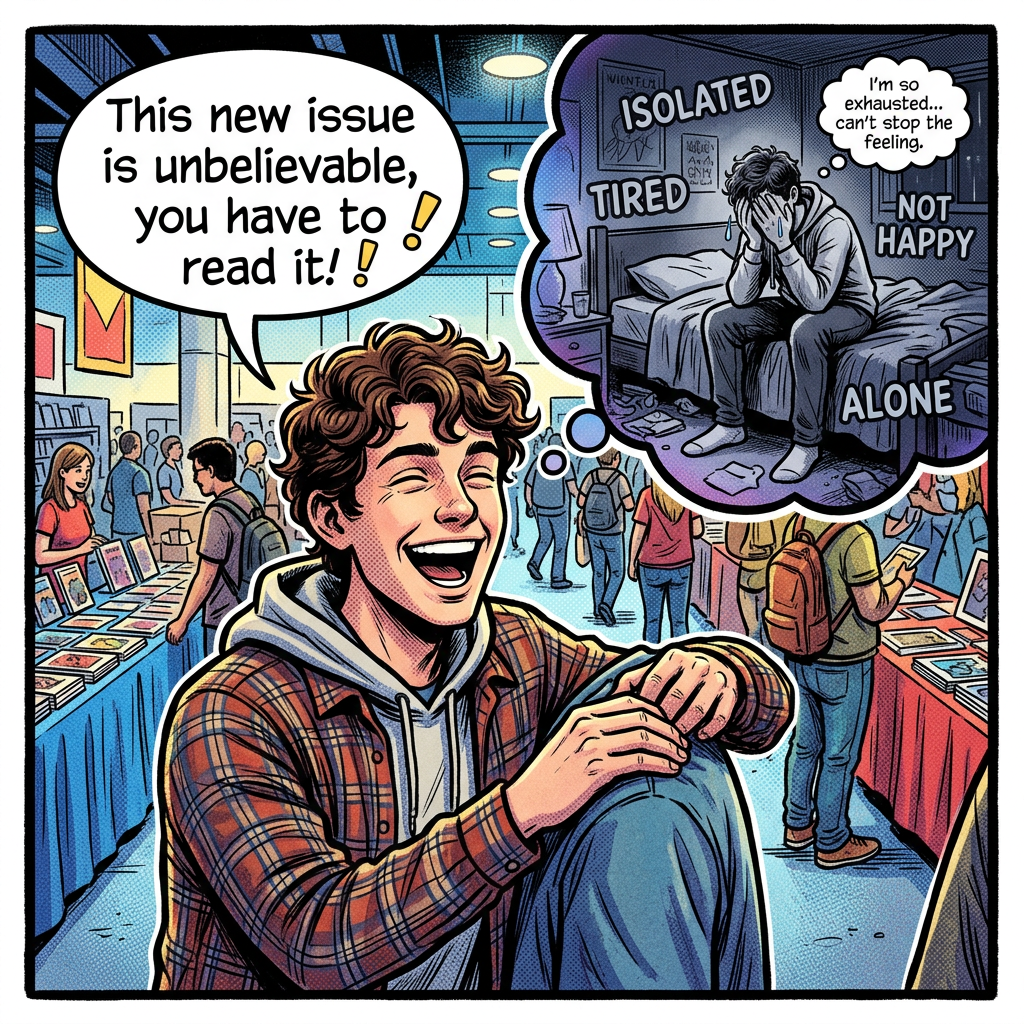
A cheerful convention attendee conceals feelings of isolation, exhaustion, and unhappiness behind a bright smile.
Telling someone they need to be happy all the time quietly tells them something is wrong with them whenever they’re not. And the truth is, no one is happy 100% of the time; that’s not a personal failure, it’s just how happiness works.
Worse, pushing nonstop happiness as the goal can edge toward something that looks a lot like mania once it’s sustained too long or too forcefully. Authenticity matters more than constant cheerfulness. A person who’s “on” all the time, no exceptions, is worth a second look, not celebration.
Faking it also has a real cost. Forcing yourself to perform happiness instead of working through what you’re actually feeling leads to burnout, and once you experience burnout, it’s much harder to recover from than an honest bad day ever was.
A Better Way to Talk About It
Sadness isn’t the same as depression. Feeling disturbed, sad, or grieving something doesn’t mean you’re broken; it means you’re human, and you’re allowed to feel it. Letting people name their emotions accurately, instead of forcing everything into “happy” or “not happy,” gives them room to actually process what’s going on.
A healthier approach looks like this: something good happens, you notice it, you sit in gratitude for it, and happiness grows out of that rather than demanding a constant happy state and panicking when it slips.
The Real Misconception
The myth isn’t that happiness exists. It’s that happiness is supposed to be constant. It isn’t, and it was never meant to be. What we should actually be building day to day is contentment and joy, with happiness as the bright, occasional spark that visits on top of them. Once we stop conflating the three, we can finally use the right language for what we’re feeling and stop mistaking an honest bad day for a sign that something’s broken.
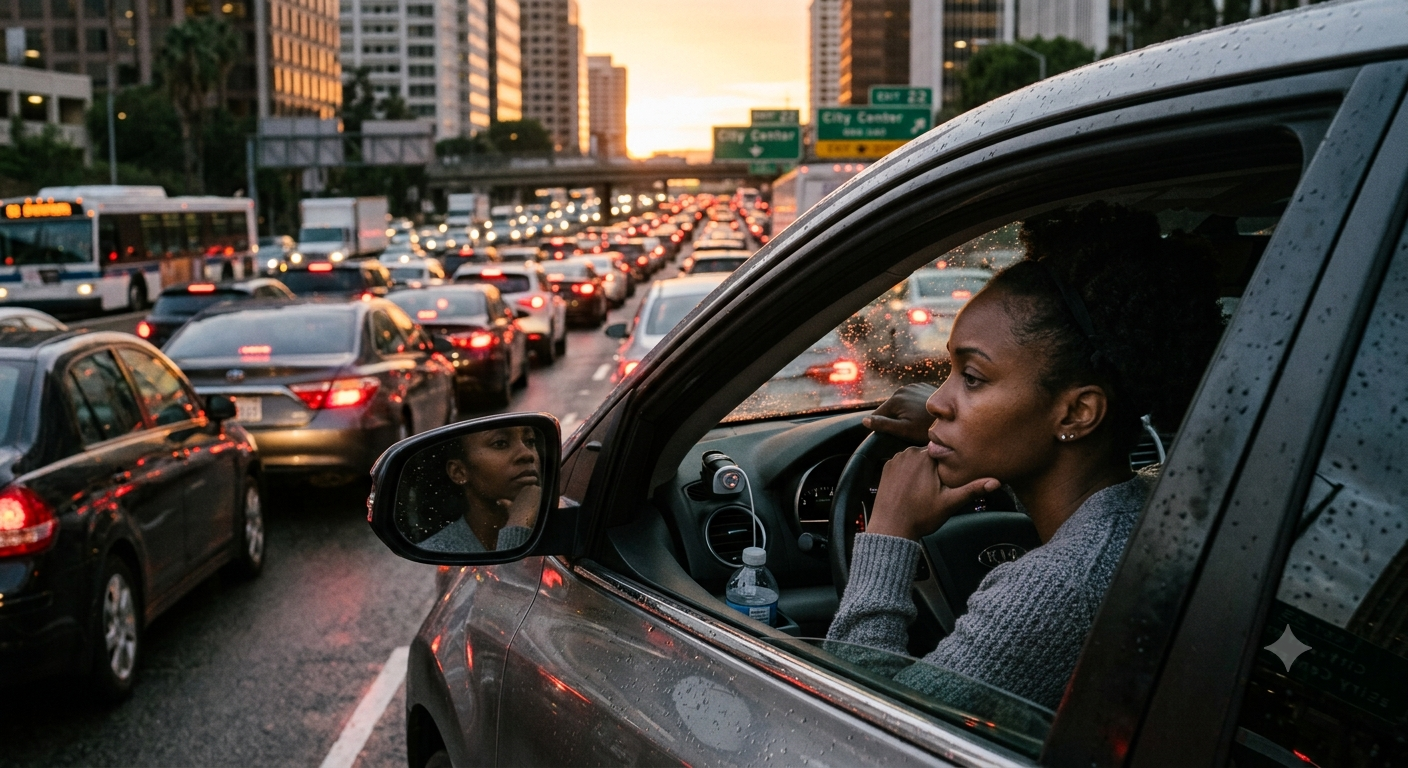
An Open Letter to Every Bad Driver in Baltimore (You Know Who You Are) Let me set the scene. It’s Saturday morning. I have one goal: get to my free dance fitness class, get my sun, get my vitamin D, be shining and brined. Instead, I get a masterclass in why nobody in this city knows how to drive anymore. Here’s what happened, and here’s everything I learned about humanity in the process.
The GPS Lied to Me My GPS said ten minutes. I believed it, because apparently I have not learned my lesson after twenty-some years of this app betraying me. Ten minutes turned into fifteen minutes stuck in one spot, for a destination that was two minutes away. Two. Minutes. Why? Construction, and zero traffic cops to direct the chaos. So there I sat, marinating in my own poor life choices, wondering if I should just park and walk the rest of the way. (I did not. I am not that strong.) Do Not Block the Intersection, I Am Begging You!
This is not a suggestion. This is not a vibe. This is the law, and yet every single day someone decides their five minutes matter more than four lanes of traffic. If you block the box, you are now sitting in the intersection on a red light, which means you have doubled the violation. You didn’t save time. You created a second traffic jam on top of the first one. Congratulations, you’re now the problem and the punishment. Nobody Uses Their Turn Signal Anymore and I Refuse to Accept This When did we all collectively decide that using a blinker was optional? It is not optional. It is a tool. It exists so the person behind you does not have to guess your intentions like you’re a mystery box. If I’m going straight and my signal isn’t on, do not honk at me because you wanted to turn. That’s a you problem. Slow down or go around. I promise I will not take it personally if you pass me, in fact I might speed up out of spite, and then you’ll be mad for a whole new reason.
A Brief and Unnecessary Physics Lesson If you’re riding my bumper in the right lane while I do the speed limit, please know that I have done the math. Going five or ten miles over the limit does not get you there dramatically faster. It gets you there a few minutes faster and significantly more likely to be dead. Force equals mass times acceleration, the human body can only absorb so much of that force before something inside you gives up, and I would like to keep my organs exactly where they are. Speed limits exist because somebody already did this math for us. Take the win. (Side-eye directed squarely at anyone doing seventy-five in a fifty-five like the laws of physics were personally written to inconvenience them.)
To the Person Doing 35 on I-95 During Rush Hour
Listen here, hon, I need you to hear me before I call you stupid or ask, “Are you Dumb?” The highway is not the place for this. If your car cannot safely handle highway speeds, that’s a mechanical problem, not a personality trait, and it needs to go to a shop, not onto a road where everyone else is doing sixty-five. If you’re scared to drive at highway speed, there is no shame in that, truly, but the solution is a rideshare or a rental, not turning I-95 into a rolling roadblock at nine in the morning. City streets exist. Please use them. Everyone Is Just Rude Now, and I’m Tired No signals. No thank-you waves. No basic courtesy. Just horns, attitude, and everybody acting like their destination is more important than everyone else’s. Traffic isn’t just bad because of construction or rush hour. It’s bad because we collectively stopped being decent to each other behind the wheel. It’s a two-way street, literally, and treating it like your own personal racetrack does not make you look powerful. It makes you look like you have somewhere to be and nowhere to grow. The Only Solution That Actually Worked I put on Prince’s “Purple Rain.” Traffic cleared shoot out to Goddess Inanna for that vibration hack( https://www.instagram.com/reel/DWIOdglAC2U/?stkn=MXQ2cGN4a3NwMWJ5cw==) . This has now worked for me twice, so as far as I’m concerned it’s science at this point, not a coincidence. Do with that information what you will.
In Conclusion If you don’t remember the rules of the road, go take a defensive driving refresher. If you’re an aggressive driver because you have a big truck and main character energy, maybe put some of that gas money toward therapy instead. I say this with love, and also as someone who is absolutely one of the bad drivers sometimes. We are all works in progress out here. I missed my dance class. I made it to my backup class instead, because I refuse to let bad drivers take two workouts from me in one day. And honestly, that might be the real lesson here: traffic will test you, but it will not stop you from getting your steps in. Drive safe. Use your signal. Don’t block the box. And maybe put on some Prince.